
Most enterprise AI conversations are still asking the wrong question. They ask, "Which agents should we build?" The better question is, "What operating layer will let us trust any agent we build?"
That distinction matters because agentic AI has moved faster than enterprise architecture. In the past year, AI agents shifted from innovation labs into production workflows across IT, customer support, finance, software engineering, and operations. Mayfield's 2026 CXO survey found that 42% of surveyed enterprises already have agents in production and 72% are either in production or active pilots. The same survey found that 60% lack a formal AI governance framework. That gap is where the next wave of failures will happen.
The failure mode will not look like a chatbot saying something embarrassing. It will look like an agent calling the wrong tool, approving the wrong refund, changing the wrong data, exposing the wrong customer record, or spending $40,000 in model calls while trying to finish a task that should have stopped after 6 minutes. The model may be smart. The workflow may be valuable. The operating layer may still be missing.
This is why enterprises need an agentic control plane. Not a slide deck. Not a review board that meets every quarter. A runtime layer that governs what agents can do, proves what they did, measures whether it worked, and limits damage when confidence drops.
The Agent Problem Is Now an Operating Model Problem
The first generation of enterprise AI work focused on isolated assistants. A team built a document summarizer. Another team built a customer support copilot. A third team built a proposal drafting tool. Each project had its own prompts, data connectors, access pattern, evaluation method, and approval process.
That worked while the systems only advised. It breaks when agents act.
An agent that drafts a proposal is useful. An agent that updates CRM fields, pulls pricing, writes a compliance matrix, creates tasks, asks a human for missing evidence, and submits a final package is a different class of system. It has identity. It has memory. It uses tools. It changes records. It may touch regulated data. It may spend money. It may trigger downstream work that humans assume has already been checked.
McKinsey's 2026 technology agenda frames the CIO shift clearly: technology leaders are becoming strategy architects, and AI has become the top investment area for many companies. Their research also notes that agentic AI forces architecture decisions on monthly timelines, not traditional 3 to 5 year planning cycles. In other words, the enterprise cannot wait for perfect standards before building. But it also cannot keep shipping disconnected agents with project-level controls.
The operating model has to change from "approve an AI use case" to "operate a fleet of autonomous actors."
That fleet needs the same kind of shared platform discipline that cloud teams learned over the last decade. You would not let every application team invent its own IAM model, logging strategy, deployment pipeline, incident response process, and cost allocation method. Yet that is exactly how many enterprises are currently deploying agents.
Governance Is Runtime Infrastructure
Most governance programs fail because they define policy far away from the action. A governance committee can say that agents should not access payroll data. That does not matter if the agent has a tool token that can query the HR system and nobody checks the request before it runs.
For agents, governance has to sit between reasoning and action. The agent can decide what it wants to do. The control plane decides whether that action is allowed, whether it needs human approval, whether it fits the agent's identity, whether it exceeds a cost budget, and whether the result should be logged, scored, or blocked.
AWS is moving in this direction with Amazon Bedrock AgentCore. AgentCore Policy intercepts tool calls through AgentCore Gateway and evaluates whether an agent can access a tool, API, Lambda function, MCP server, or third-party service. AgentCore Evaluations scores real agent behavior for dimensions such as correctness, helpfulness, tool selection accuracy, safety, goal completion, and context relevance. Those results appear in CloudWatch, where teams can alert on quality drops. This matters because it moves oversight from after-the-fact review into the runtime path.
The broader market is converging on the same point. Gartner's 2026 Hype Cycle for Agentic AI calls out governance, security, and FinOps for agentic AI as distinct concerns that are emerging alongside agent platforms, orchestration, communication frameworks, and agent development practices. That is the signal. Enterprises are learning that the agent is not the platform. The controls around the agent are the platform.
An agentic control plane should make five things explicit:
- Who or what the agent is acting as
- Which tools and data the agent can touch
- What evidence is required before it acts
- How quality, cost, and outcome are measured
- When a human must approve, reverse, or stop the workflow
If those decisions live inside prompt text, the system is not ready for production.
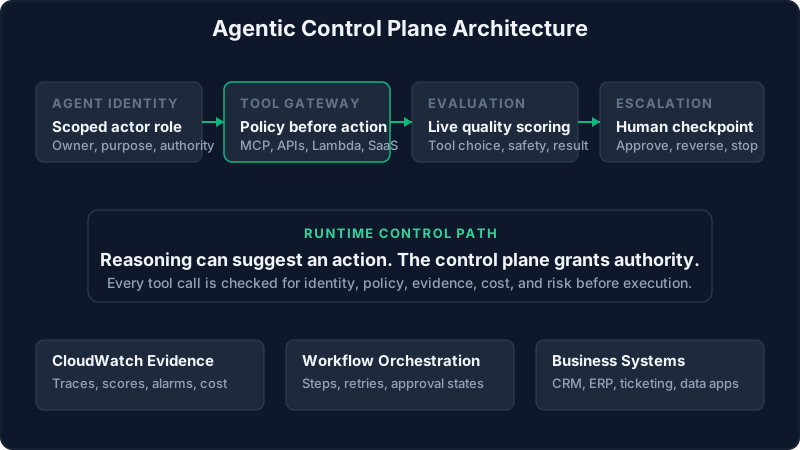
The Five Layers of an Agentic Control Plane
The control plane is not a single product category. It is an architecture pattern. Most enterprises will assemble it from AWS services, existing identity systems, observability platforms, workflow engines, policy engines, and custom application logic.
The important point is not whether every component comes from one vendor. The important point is that every agent action passes through a consistent operating layer.
| Layer | Primary Question | Enterprise Control | Failure If Missing |
|---|---|---|---|
| Identity | Who is the agent acting as? | Agent identity, scoped roles, owner mapping | Shared tokens hide accountability |
| Tool Gateway | What can the agent touch? | Policy checks before API, MCP, and Lambda calls | Agents reach systems beyond their purpose |
| Evaluation | Did the agent do the task correctly? | Live scoring for tool choice, accuracy, safety, and outcome | Bad behavior is found after customers feel it |
| Cost Control | How much autonomy can this task afford? | Token budgets, retry limits, model routing, stop rules | Small tasks become expensive loops |
| Escalation | When must a human decide? | Approval thresholds, rollback paths, incident triggers | High-impact actions happen without review |
The identity layer is the foundation. Every production agent should have a distinct identity, owner, role, and permitted action set. Do not let agents borrow human credentials. Do not let 12 agents share one service account. The audit trail should answer a simple question: which agent took which action, under whose authority, in which workflow, and based on what evidence?
The tool gateway layer is where autonomy becomes enforceable. MCP servers, internal APIs, Lambda functions, SaaS integrations, SQL queries, and workflow actions should not be handed directly to agents. They should sit behind a gateway that checks action, resource, user context, workflow state, data sensitivity, and confidence score. If an agent is allowed to retrieve a product catalog but not update pricing, that rule belongs in the gateway, not in a prompt.
The evaluation layer turns subjective trust into measurable behavior. Did the agent choose the right tool? Did it pass the correct parameters? Did it cite the right source? Did the action reach the intended outcome? Did the answer match policy? Did user satisfaction drop by more than a defined threshold? These scores should become CloudWatch alarms, Jira tickets, rollback triggers, and release gates.
The cost layer is where many agent programs are still immature. A human can recognize when a workflow is going nowhere. Agents need explicit budgets. A procurement agent may get 12 tool calls, 3 model retries, and $0.80 of model spend before it must stop or escalate. A proposal agent may get a larger budget because the work is worth more. Cost policy should vary by workflow value, not by model vendor default.
The escalation layer is the difference between automation and negligence. An agent that recommends a refund is different from an agent that issues it. An agent that drafts a migration plan is different from one that opens production change tickets. High-impact actions need approval thresholds, rollback paths, and owner notification. Human-in-the-loop should mean specific decision checkpoints, not vague comfort.
The CIO Decision: Add Agents or Redesign the Operating Layer
McKinsey describes the core architecture choice as incremental integration versus broader transformation. That framing is useful, but for agents there is a third path: build the control plane first, then let workflows adopt agents in phases.
This avoids two bad extremes.
The first bad extreme is uncontrolled experimentation. Business teams buy or build agents one at a time. They move fast for 90 days. Then the CIO discovers 40 workflows, 12 model providers, 8 data access patterns, no shared audit log, and no way to explain cost by business outcome. The work looked agile until it became ungovernable.
The second bad extreme is central paralysis. The enterprise creates a governance program that requires every agent idea to pass a long approval sequence before touching real systems. Teams route around it. Shadow AI grows. The official program becomes a blocker, not an operating model.
The control plane path is different. It gives teams a paved road. If they build within the control plane, they get approved identities, tool gateways, observability, cost reporting, evaluation templates, and escalation patterns. If they want to bypass those controls, they need an explicit exception.
That is how cloud platforms matured. The winning pattern was not "nobody can deploy infrastructure." It was "teams can deploy quickly through approved patterns with guardrails built in." Agentic AI needs the same platform shift.
Where AWS AgentCore Fits
AWS AgentCore is important because it moves several control plane capabilities into managed infrastructure. That does not mean every enterprise agent should be built only on AgentCore. It does mean AWS has made the enterprise architecture pattern clearer.
AgentCore Gateway and Policy address tool-call control. AgentCore Evaluations address quality scoring. AgentCore Observability gives teams traceability and CloudWatch integration. AgentCore Memory supports longer-running agent behavior where experience and context matter. Support for MCP means enterprises can connect agent tools without forcing every integration into a one-off API pattern.
For Tactical Edge clients, the practical architecture often looks like this:
- 1IAM and identity provider mapping define agent roles, owners, user context, and permitted workflows.
- 2AgentCore Gateway or a custom gateway mediates access to tools, MCP servers, internal APIs, and Lambda functions.
- 3Policy checks run before tool calls, with some policies enforced and others logged while teams tune thresholds.
- 4CloudWatch and application telemetry capture traces, evaluation scores, token spend, tool latency, and failure reasons.
- 5Step Functions or event-driven workflows manage multi-step execution, approvals, retries, and rollback.
- 6Business systems receive only approved actions, with full audit context attached.
This pattern matters because it separates the agent's reasoning from the enterprise's authority. The model can suggest an action. The control plane decides whether the action is allowed.
That separation is the basis for safe autonomy.
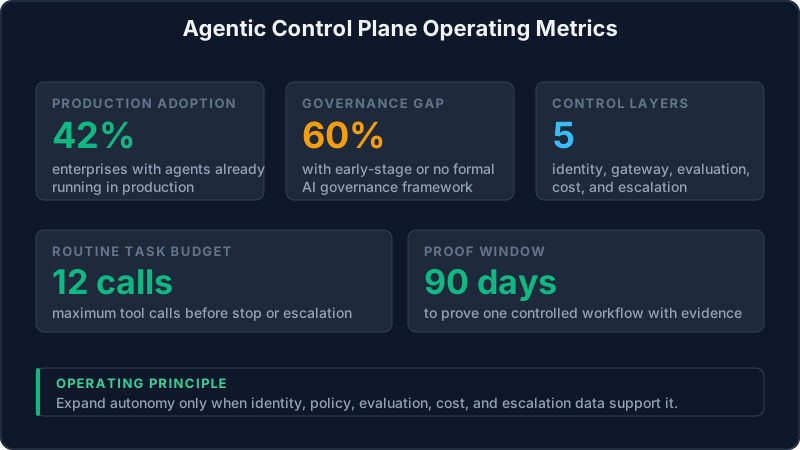
Agentic FinOps Belongs in the Architecture
Most AI cost programs start too late. Finance notices a cloud bill spike, asks engineering for an explanation, and discovers that the cost is spread across model calls, vector retrieval, reranking, embeddings, retries, evals, and tool execution. By then, waste has become workflow behavior.
Agents make this harder because they can call models repeatedly while pursuing a goal. A single user request can trigger planning, retrieval, tool selection, tool execution, reflection, validation, and response generation. If the task fails, the agent may retry with a different plan. If the workflow design is loose, the agent may spend more money trying to recover than the task is worth.
Agentic FinOps cannot be a monthly spreadsheet. It has to run inside the control plane.
Every production workflow should define:
- Maximum model spend per task
- Maximum tool calls per task
- Maximum retries per failure type
- Default model route by step
- Cache policy for repeated context
- Stop conditions for low-confidence loops
- Cost per successful business outcome
The last metric matters most. Cost per model call is not enough. Cost per resolved support case, approved proposal section, completed compliance check, or avoided incident tells you whether autonomy is paying for itself.
This is where Tactical Edge can be more useful than generic AI governance content. Governance, observability, and FinOps are not separate programs. They are the same control plane viewed from different angles. Identity says who can act. Policy says what can happen. Evaluation says whether it worked. FinOps says whether the outcome was worth the resources. Escalation says when humans must take over.
A 90-Day Roadmap
Do not begin by building a universal agent platform. Begin with one workflow where the value is visible and the risk can be bounded.
Days 1-15: Pick the workflow and define the action boundary. Choose a workflow with repeatable decisions, measurable outcomes, and clear system interfaces. Examples: incident triage, proposal compliance review, support case routing, procurement exception handling, renewal risk detection. Define what the agent may recommend, what it may execute, and what always requires approval.
Days 16-30: Build the identity and tool gateway. Give the agent its own identity. Put every tool behind a gateway. Start with allow lists, scoped roles, structured tool schemas, and full audit logs. Block direct database or SaaS access from the agent runtime.
Days 31-45: Add evaluation and traceability. Score tool choice, argument accuracy, source grounding, policy compliance, and task outcome. Record traces in a place operations teams already use. CloudWatch is a good default for AWS-centered systems.
Days 46-60: Add cost budgets and stop rules. Set token, retry, tool-call, and elapsed-time budgets per task. Require escalation when the task exceeds budget or confidence drops below threshold.
Days 61-75: Run in observe mode. Let the agent recommend actions without executing high-impact steps. Compare recommendations against human decisions. Tune policies and evaluations based on observed misses.
Days 76-90: Enable controlled action. Allow the agent to execute low-risk actions and route high-risk actions to approval. Report weekly on task volume, completion rate, human override rate, error rate, cost per outcome, and hours returned to teams.
The Thought Leadership Shift
The next phase of enterprise AI will not be won by companies that build the most agents. It will be won by companies that operate agents with the same discipline they apply to cloud infrastructure, security, and financial controls.
That is the real shift. Agentic AI is not a feature added to the software estate. It is a new class of actor inside the enterprise. Actors need identity. Actions need policy. Decisions need evidence. Systems need observability. Costs need budgets. Exceptions need owners.
Enterprises that treat agents as isolated applications will accumulate another layer of technical debt. Enterprises that treat agents as a fleet, governed through a shared control plane, will move faster because teams will know where the boundaries are.
The opportunity for CIOs is not to approve more experiments. It is to give the business a reliable path from experiment to operation. The control plane is that path.
At Tactical Edge, this is how we think about production agentic systems: start with the workflow, define the authority boundary, build the operating layer, measure outcomes, and expand autonomy only when the evidence supports it. The model is only one component. The system around the model determines whether the enterprise can trust it.