
Healthcare does not need another transactional queue. It needs an operating layer that can gather evidence, apply policy, coordinate teams, and keep a human in the loop when the decision touches clinical judgment or member trust.
That is the Tactical Edge point of view on agentic AI in healthcare. The strongest use cases are not generic chatbots. They are coordinated workflows where an agent can read from the EHR, claims platform, care management system, contact center, and payer rules engine, then prepare a next-best action with evidence, audit trail, and escalation path.
The industry is already being pushed in this direction. CMS finalized interoperability and prior authorization requirements that make FHIR APIs central to data exchange, with major API requirements generally beginning in 2027 (CMS). CMS also projects national health spending growth to outpace GDP growth from 2025 through 2034 (CMS NHE). At the same time, administrative friction remains expensive: CAQH reported a multi-billion-dollar savings opportunity from moving remaining manual administrative transactions to electronic workflows (CAQH), and AMA survey reporting continues to show prior authorization creates delays and heavy staff burden (AMA).
The opportunity is not "AI that answers questions." It is AI that changes how healthcare work moves.
The Problem Is Transaction Design, Not Missing Software
Most healthcare operations were designed as handoffs between systems. Eligibility check. Documentation request. Nurse review. Payer determination. Outreach. Appeal. Case update. Quality measure closure. Each handoff leaves a trail, but the trail is spread across portals, PDFs, faxes, APIs, task queues, call notes, and spreadsheets.
The result is predictable. Staff re-enter the same facts. Clinicians review incomplete evidence. Members receive outreach after the avoidable event has already happened. Leaders buy dashboards that describe the backlog but do not change the operating model that created it.
Agentic AI only matters if it changes that model. A useful healthcare agent does not just summarize a chart. It does the work around the chart: it finds missing evidence, maps a request to policy, checks benefit rules, prepares a determination packet, routes uncertain cases to the right human, and records why the action was recommended.
That requires orchestration, not another point solution.
Tactical Edge Reference Architecture
Our healthcare agent architecture has five layers. Each layer has a different job, and the separation matters because healthcare agents need the freedom to coordinate work without gaining uncontrolled access to protected data.
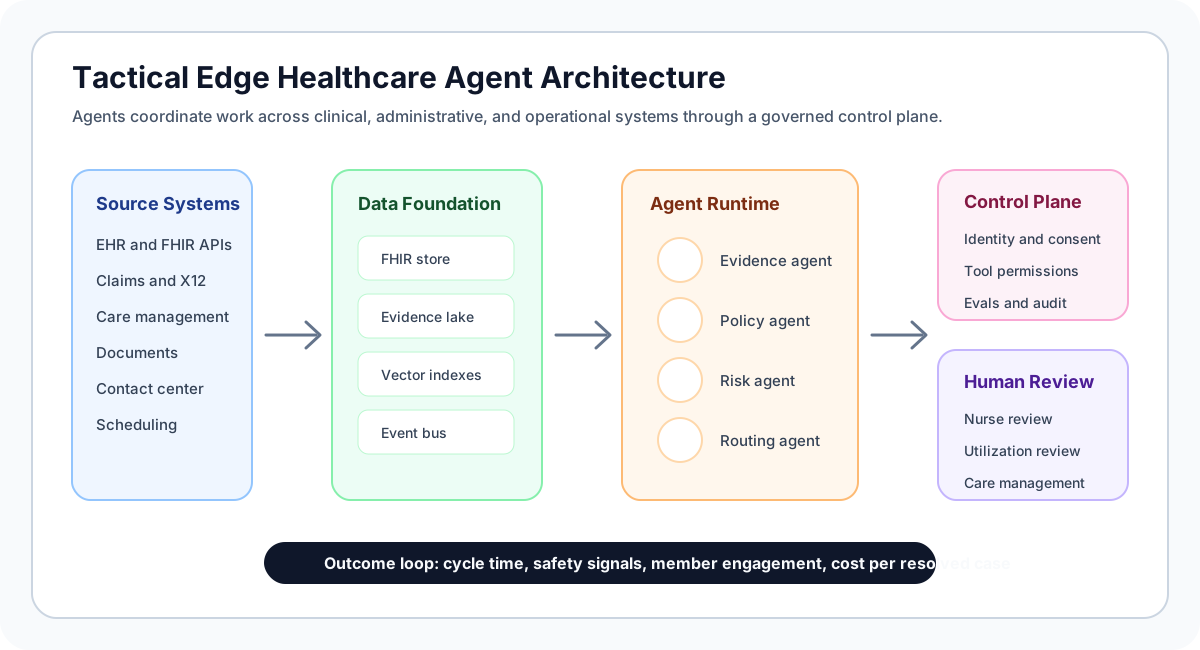
System integration layer. This is where EHR, claims, care management, scheduling, contact center, document stores, and payer portals connect through FHIR, HL7, X12, APIs, file feeds, and secure adapters. The agent does not scrape everything by default. It calls approved tools with scoped permissions.
Healthcare data foundation. Events, documents, claims, observations, member preferences, and care plans land in governed storage. On AWS, this often means HealthLake or FHIR-native APIs for clinical exchange, S3 for document evidence, Glue and Athena for analytical joins, and OpenSearch or vector indexes for retrieval.
Agent runtime. Specialized agents handle evidence retrieval, policy matching, risk scoring, outreach preparation, and work routing. They do not make every decision. They prepare the case, explain the evidence, and execute low-risk steps inside policy.
Control plane. Every agent action is checked against identity, consent, data-minimization rules, approval thresholds, PHI redaction requirements, and model evaluation. This is where prompt injection defenses, tool permissions, audit logging, and quality checks live.
Human review and outcome loop. Nurses, utilization reviewers, care managers, physicians, and operations leads stay in the workflow. The system escalates ambiguous or high-risk decisions, learns from dispositions, and updates evaluation datasets based on production misses.
This architecture is intentionally not model-centric. Foundation models are swappable. The durable asset is the control plane, workflow graph, evidence store, and evaluation harness around the model.
Where Agents Fit First
Healthcare leaders should start where three conditions are true: the workflow is repetitive, the evidence is distributed, and the final action can be bounded by policy.
| Workflow | Agent responsibility | Human role | Outcome metric |
|---|---|---|---|
| Prior authorization intake | Gather clinical evidence, match policy, draft request packet | Review exceptions and denials | Time from request to complete packet |
| Care gap closure | Identify eligible members, prepare outreach, track completion | Approve campaigns and handle complex member needs | Closed gaps per care manager hour |
| Discharge follow-up | Reconcile discharge notes, schedule touchpoints, flag risk | Intervene on high-risk transitions | Avoided readmissions and completed follow-ups |
| Appeals preparation | Assemble denial reason, evidence, criteria, and timeline | Review argument and submit final appeal | Appeal cycle time and overturn rate |
| Population risk review | Surface rising-risk cohorts and recommended actions | Prioritize clinical programs | Intervention acceptance and impact |
The point is not to remove staff. The point is to stop using clinical and operations talent as glue between systems.
A Prior Authorization Workflow Built for Agentic AI
Prior authorization is a good example because it combines policy, documentation, clinical context, payer rules, and time pressure. The wrong automation design simply moves a fax into a portal. The right design turns a fragmented process into an auditable workflow.
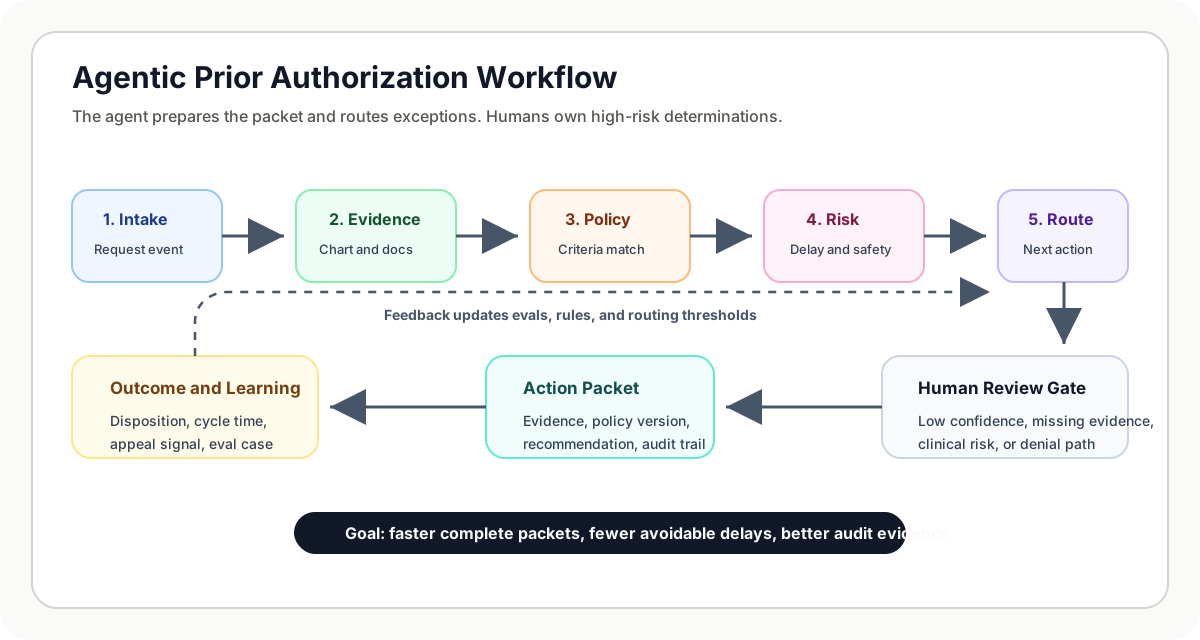
In our model, an intake event triggers a workflow, not a task. The evidence agent checks the EHR and attachments for required documentation. The policy agent maps the request to benefit rules and clinical criteria. The risk agent checks whether delay creates member safety risk. The communication agent drafts missing-information requests or member updates. The reviewer agent assembles the full packet and routes it to a human when confidence, policy, or risk thresholds require review.
The workflow definition should be explicit enough for engineering, compliance, and clinical operations to inspect:
workflow: prior_authorization_packet
trigger: new_authorization_request
agents:
  evidence_agent:
    tools: [ehr_read, document_extract, fhir_search]
    output: clinical_evidence_summary
  policy_agent:
    tools: [benefit_rules, medical_policy_lookup]
    output: criteria_match_report
  risk_agent:
    tools: [risk_model, medication_history, encounter_history]
    output: delay_risk_score
  reviewer_router:
    rules:
      - if: delay_risk_score > 0.72
        route: nurse_review
      - if: criteria_match_report.confidence < 0.86
        route: utilization_review
      - if: missing_required_evidence == true
        route: request_information
audit:
  store: immutable_event_log
  include: [tool_calls, evidence_ids, policy_version, reviewer_action]
This is the difference between automation and accountable agentic operations. The system is not hiding the decision path. It is creating a better one.
Safety Requires Policy, Evaluation, and Audit in the Same Loop
Healthcare agents need more than access control. They need bounded autonomy. A retrieval agent should not be able to call an outreach tool. A communication agent should not be able to infer a diagnosis from incomplete evidence. A policy agent should use the current policy version and preserve the reference IDs that led to its recommendation.
We implement this with three gates.
Tool gates define what each agent can read, write, and trigger. The permissions are role-specific and patient-context-specific.
Decision gates define when the system may draft, route, auto-close, request more information, or escalate. Clinical judgment and adverse coverage decisions require explicit human ownership.
Evaluation gates measure whether the agent used correct evidence, followed policy, avoided unsupported claims, and escalated the right cases. Failed evals become regression tests before the next release.
A simplified evaluation harness can look like this:
type EvalCase = {
  requestId: string
  expectedRoute: "auto_packet" | "nurse_review" | "utilization_review"
  requiredEvidenceIds: string[]
  prohibitedActions: string[]
}

function evaluateAuthorizationRun(run: AgentRun, test: EvalCase) {
  return {
    routeCorrect: run.finalRoute === test.expectedRoute,
    evidenceComplete: test.requiredEvidenceIds.every((id) =>
      run.evidenceIds.includes(id)
    ),
    noProhibitedAction: test.prohibitedActions.every((action) =>
      !run.actions.includes(action)
    ),
    citedPolicyVersion: Boolean(run.policyVersion),
  }
}
This is not academic overhead. It is how a health system can prove that an agent improved operations without creating an invisible clinical or compliance risk.
What Tactical Edge Builds
Tactical Edge builds healthcare agent systems as production operating layers on AWS. The offering includes the architecture, integrations, workflow design, governance model, evaluation harness, and dashboards required to move from pilot to monitored production.
| Capability | What we build | Why it matters |
|---|---|---|
| FHIR and workflow integration | Secure adapters for EHR, claims, care management, documents, and contact center systems | Agents need complete context without uncontrolled access |
| Multi-agent orchestration | Evidence, policy, risk, outreach, and routing agents with bounded tools | Complex work is divided into inspectable responsibilities |
| Healthcare control plane | Consent, PHI minimization, tool permissions, policy versions, audit logs, evals | Autonomy stays inside clinical and compliance boundaries |
| Human review console | Work packets, evidence summaries, recommendation rationale, reviewer actions | Staff see the reason for action, not a black-box answer |
| Outcome analytics | Cycle time, avoided manual touches, escalation accuracy, member engagement, cost per resolved case | Leaders can measure operating impact, not demo activity |
The strongest first deployment is usually a 6 to 10 week controlled workflow around prior authorization intake, care-gap closure, discharge follow-up, or appeals preparation. We define the workflow, connect the minimum needed systems, create evaluation cases from historical examples, and run the agent beside existing teams before expanding the action surface.
The New Healthcare Operating Metric
Healthcare organizations often measure tasks completed, calls made, documents processed, and requests closed. Those numbers matter, but they can hide the real question: did the workflow produce a safer, faster, lower-friction outcome?
The metric we recommend is cost per resolved outcome with safety controls attached. For prior authorization, that means administrative cost per complete and review-ready packet, plus clinical escalation accuracy and member delay risk. For care management, it means cost per closed care gap, plus outreach equity and intervention acceptance. For discharge follow-up, it means cost per completed follow-up, plus readmission signal tracking.
Agentic AI earns its place when it improves that unit economics and leaves a better audit trail than the manual process it replaced.
FAQ
Can healthcare agents make clinical decisions? They should not own clinical judgment. They can gather evidence, summarize context, apply deterministic policy checks, draft recommendations, and route work. Licensed or accountable humans own high-risk clinical and coverage decisions.
Does this require replacing the EHR or care management platform? No. The architecture sits beside existing systems and connects through FHIR, HL7, APIs, secure file exchange, and approved workflow integrations.
Where should a payer or provider start? Start with a workflow where evidence is distributed but decision rules are inspectable: prior authorization intake, appeals preparation, care-gap closure, discharge follow-up, or referral coordination.
How do we know the agent is safe enough for production? Treat safety as a release gate. Build eval cases from historical workflows, run shadow mode, compare agent routes to human dispositions, and require audit logs for every tool call and recommendation.
The future of healthcare AI is not a chatbot on top of a broken process. It is an accountable operating layer that coordinates data, policy, teams, and action around measurable outcomes.