
Your enterprise AI vendor just sent you a proposal. The deck is gorgeous. The demo is flawless. The POC worked perfectly in three weeks. Your executive sponsor is ecstatic.
You will never ship this to production.
I have watched this exact pattern destroy $2.4M initiatives at three Fortune 500s in the past eighteen months. The POC wins awards. The production deployment dies in committee six months later. The vendor blames your "organizational readiness." Your team knows the truth: the architecture was theater from day one, optimized for conference room applause instead of operational survival.
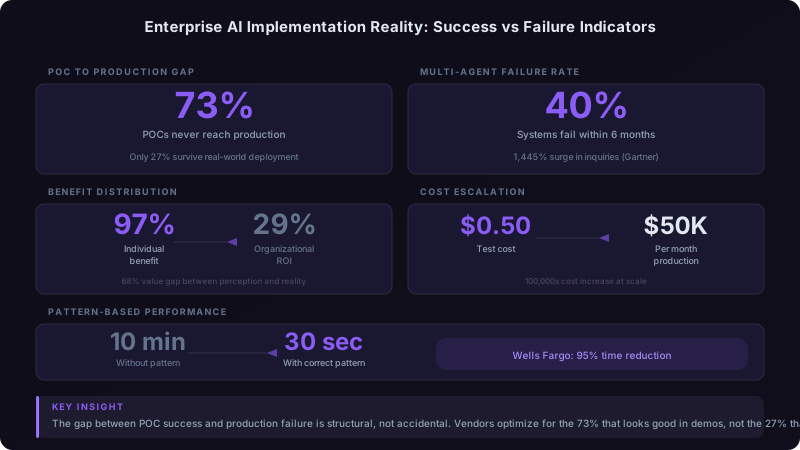
The $2.4M POC That Never Shipped
The structural incentives are backwards. Vendors get paid for successful POCs, not durable production systems. They optimize for what gets them to contract signature: impressive demos, fast time-to-wow, executive-friendly metrics that evaporate under operational load.
Here's what that looks like in practice. The vendor hardcodes responses for your demo dataset. They skip the metadata architecture conversation because it would add three months to the timeline. They build a multi-agent orchestrator because it looks sophisticated in slides, even though Princeton NLP research shows single agents match or outperform multi-agent systems on 64% of benchmarked tasks when given the same tools and context.
The POC succeeds because it runs on twelve handpicked test cases. Production fails because real users generate ten thousand edge cases in the first week, and nobody architected for the 97th percentile latency or the hallucination rate under adversarial input. The vendor's Statement of Work included "AI implementation services" but zero milestones around evaluation infrastructure, metadata maturity assessment, or bounded autonomy architecture.
Red flags in vendor proposals:
- Timeline padded with "discovery" phases: If they need four months to understand your use case, they haven't done this before
- Vague "production readiness" milestones: Real milestones specify latency SLAs, hallucination rate thresholds, escalation accuracy targets
- No mention of metadata architecture: Intelligence comes from your enterprise context, not their model, if they skip this conversation, they're selling demos
- Payment structure front-loaded: Vendors confident in production success tie compensation to post-deployment performance, not POC completion
- Multi-agent architecture as the default: Question why you need orchestrator-worker patterns when 64% of enterprise tasks perform better with properly configured single agents
The gap between POC theater and production reality is structural, not accidental. Vendors know how to win the evaluation phase. Very few know how to survive contact with real users at scale.
Architecture Decisions That Determine Production Fate
The orchestration pattern you choose in week two determines whether your system survives month six. This is not a model selection problem. This is not a prompt engineering challenge. This is pure architecture.
Wells Fargo deployed an orchestrator-worker pattern for 35,000 bankers accessing 1,700 procedures across retail, commercial, and wealth management lines. The system reduced procedure lookup time from ten minutes to thirty seconds. The critical decision: they chose hierarchical decomposition with a planning agent routing to specialist execution agents, rather than a single monolithic agent attempting all tasks or a free-form collaboration pattern where agents negotiate responsibilities.
That pattern choice matters more than whether they used Claude or GPT-4. Gartner tracked a 1,445% surge in multi-agent system inquiries from Q1 2024 to Q2 2025, but 40% of those pilots fail within six months of production deployment. The failure mode is predictable: teams build complex orchestration layers because they look sophisticated, then discover that coordination overhead crushes performance and cost explodes under real load.
Cost explosion is systemic, not accidental. A workflow that costs $0.50 in testing can hit $50,000 per month at 100,000 executions if poorly architected. Each agent invocation triggers multiple LLM calls. Each context handoff burns tokens. Each failed coordination loop retries indefinitely because nobody built circuit breakers. The POC ran on 100 test cases. Production runs on 100,000 real cases with edge conditions nobody anticipated.
Princeton NLP research should terrify your vendor: single agents matched or outperformed multi-agent systems on 64% of benchmarked tasks when given the same tools and context. That means two-thirds of the multi-agent architectures being sold right now are unnecessary complexity that will become operational liability. The decision tree is simple but vendors won't walk you through it because admitting simpler solutions exist kills upsell opportunities.
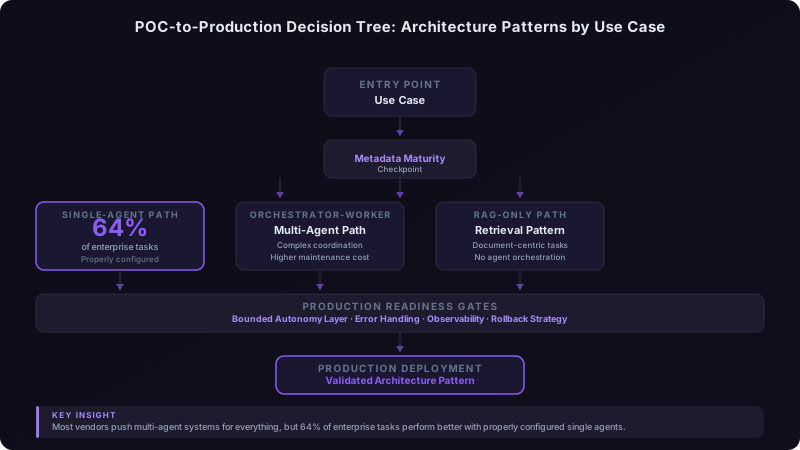
When to Use Which Pattern
Single-agent systems handle tasks with clear scope and unified context. Customer support ticket classification, document summarization, code review comments, SQL query generation against a single schema. If your task has one objective and one decision maker, a well-configured single agent with proper tool access outperforms orchestrated multi-agent architectures 64% of the time while costing 80% less to operate.
Orchestrator-worker patterns shine for decomposable workflows with specialist domains. Wells Fargo's case: one planning agent identifies which procedure applies (commercial lending vs retail deposits vs wealth management), then routes to specialist agents with domain-specific retrieval. Each specialist has bounded context, reducing hallucination risk and token costs. The orchestrator enforces workflow logic the agents themselves can't maintain.
RAG-only systems (retrieval-augmented generation without autonomous agents) work when you need information synthesis without action. Legal research, policy lookups, historical data analysis. No agent autonomy means no approval gates, no permission architecture, no runaway loops. Much simpler operational model.
The vendor who proposes multi-agent orchestration for everything is selling sophistication as a proxy for competence. Demand they justify the architecture against simpler alternatives with production cost models, not POC demo impressiveness.
The Metadata Maturity Test Your Vendor Won't Mention
Your vendor's deck shows perfect text-to-SQL results. The demo generates flawless queries against your database schema. You sign the contract. Six months later, the system is unusable.
What happened? Your company has five competing definitions of "revenue." Sales counts bookings. Finance counts recognized revenue. Product counts ARR. Customer success counts renewal revenue. Each definition lives in different tables, calculated differently, filtered by different business rules. The model has no way to know which "revenue" you mean when you ask "What was Q3 revenue by region?"
This is not a model problem. This is a metadata problem masquerading as an AI limitation. AWS re:Invent 2025 revealed a coordinated strategy acknowledging what practitioners already knew: intelligence comes from enterprise context, not model capability. AWS launched Amazon Nova Forge for custom training blending enterprise datasets with model checkpoints, signaling that context has become an infrastructure-level concern, not a bolt-on feature.
Voice agents fail because "tier 2 escalation" means different things in different departments. Code generators struggle because they lack architecture context and tribal knowledge about why the legacy monolith is structured the way it is. RAG systems hallucinate because business term ambiguity creates retrieval noise. All metadata failures, all predictable, all ignored during POC because test datasets are clean.
Your metadata maturity determines your AI ceiling. No amount of prompt engineering fixes definitional chaos. No model upgrade compensates for missing business context. If your vendor's proposal doesn't include metadata architecture assessment, they're selling you a system that will hit a performance ceiling the moment it encounters real organizational complexity.
What Good Metadata Architecture Looks Like
Your vendor should deliver specific metadata infrastructure, not vague promises of "context integration." This means a semantic layer that maps business terms to technical definitions, a glossary with version control tracking definition changes over time, lineage tracking showing how metrics are calculated from raw data, and clear ownership models for term definitions so conflicts have resolution processes.
Data platform teams and AI teams must converge on this work. Historically, data teams focused on schema design and pipeline reliability while AI teams focused on model selection and prompt optimization. That separation is now operational malpractice. The limiting factor isn't the model, it's metadata maturity. Your contract should specify deliverables around metadata architecture with the same precision as model performance SLAs.
Bounded Autonomy: The Zero-Trust Architecture Vendors Skip
Giving LLMs direct database credentials is professional negligence. Yet I see vendor proposals every month that treat security as an afterthought, slapping RBAC onto autonomous agents as if permission models designed for humans work for probabilistic systems that can be prompt-injected.
Traditional role-based access control fails for AI agents. A human with read-write database access makes deliberate decisions. An LLM with the same access can be tricked into executing arbitrary SQL through prompt injection, social engineering via retrieval context, or simple hallucination that confuses schema relationships. The attack surface is fundamentally different.
Bounded autonomy architecture: Never give LLMs direct infrastructure credentials. Route all requests through intermediate middleware APIs that enforce schema-level permissions, validate query structure before execution, and provide read-only access by default. Write operations require explicit approval gates, not just permission checks.
Wells Fargo's procedure lookup system demonstrates this in production. The agent can search 1,700 procedures across multiple business lines, but it has zero ability to modify procedures, update permissions, or access customer PII directly. All retrieval flows through APIs that enforce row-level security, redact sensitive fields, and log every access for audit. The agent is powerful within bounded rails, not autonomous in the enterprise-infrastructure-access sense that vendors hand-wave past.
Human-in-the-Loop Checkpoints
Mandatory approval gates for production system modifications. Automatic approval for read-only operations within defined scope. Human review required for: write operations against production databases, permission changes or privilege escalation, access to PII or financial data, execution of shell commands or infrastructure changes, any operation outside predefined workflow scope.
This is zero-trust architecture applied to autonomous agents. The default is "deny unless explicitly allowed" rather than "allow unless explicitly denied." Your vendor's proposal should specify exactly where approval gates live, who gets notified, what the SLA is for human review, and how the system behaves if approvals time out.
Rate limiting and circuit breakers prevent agent loops from causing production incidents. If an orchestrator retries a failed task indefinitely, it can burn through your LLM budget in hours. If a multi-agent coordination loop fails to converge, agents can trigger cascading retrieval operations that DOS your vector database. Production-ready systems have hard limits: max retries per task, timeout thresholds for agent collaboration, cost caps that pause execution if spending exceeds thresholds, circuit breakers that halt execution if error rates spike.
The Edge AI Governance Challenge
Google's Gemma 4 release obliterated the cloud security perimeter. Advanced models now run entirely on local devices, enabling multi-step planning and autonomous workflows with zero outbound traffic to monitor or control. Your cloud access security brokers, your LLM traffic gateways, your network-level controls, all irrelevant when the model executes locally.
Security teams built massive digital walls around cloud infrastructure. Edge AI bypasses all of it. The governance challenge shifts from blocking models to controlling what systems models can access: file system permissions, database connections, shell command execution, API credentials. Intent-based architecture matters more than perimeter defense.
Current vendor proposals ignore this reality entirely. They assume centralized cloud execution with controllable endpoints. Ask your vendor how their bounded autonomy architecture handles local model execution. If they don't have an answer, they're six months behind the threat model.
The 97/29 Gap: When Individual Wins Don't Scale
97% of executives report benefiting from AI individually. Only 29% see significant organizational ROI. This is not a technology problem. This is a governance architecture problem that vendors profit from ignoring.
The structural tension: business teams need direct ownership of AI workflows to move fast, but IT needs centralized control over operations to prevent chaos. Traditional enterprise software resolved this with managed SaaS platforms. AI agents operate differently. They need deep integration with enterprise systems, access to proprietary data, and the ability to execute actions across multiple tools. You can't sandbox them like Salesforce.
52% of employees already use AI agents, according to 2026 research. That number will hit 75% by year end whether IT approves or not. Companies respond in two dysfunctional ways: lock AI capabilities in technical teams, creating bottlenecks that kill business velocity, or open floodgates to ungovernable shadow AI, creating security disasters and redundant spend.
Neither works. The solution is federated capability ownership with centralized operational control. Business teams own their workflows and use cases. Platform teams own the infrastructure, security architecture, evaluation pipelines, and cost management. Marketing builds their own lead scoring agents, but those agents run on IT-managed infrastructure with enforced security controls, standardized evaluation, and centralized cost visibility.
What Federated Ownership Looks Like
Your vendor should enable this model, not fight it. That means self-service deployment workflows for business teams to launch agents within guardrails. Centralized policy enforcement for security, compliance, and cost controls that business teams can't override. Shared evaluation infrastructure so every team benefits from production monitoring without rebuilding it. Unified observability across all agents regardless of which team deployed them.
Most vendor proposals assume centralized IT ownership because it simplifies their sales process. One buyer, one contract, one deployment. But that model creates the exact bottleneck that drives 79% of organizations to report AI adoption challenges (up from 2025). 54% of C-suite executives admit AI adoption is tearing their company apart specifically because of this centralization vs velocity tension.
| Governance Model | Velocity | Control | Failure Mode | Best For |
|---|---|---|---|---|
| Centralized IT Ownership | Low (6-month backlogs) | High | Business teams build shadow AI to bypass bottlenecks | Regulated industries with strict compliance |
| Decentralized Free-for-All | High (days to deploy) | None | Security disasters, redundant spend, ungovernable sprawl | Early experimentation phase only |
| Federated with Platform Controls | High (self-service) | High (enforced) | Requires platform investment upfront | Production enterprise AI at scale |
| Vendor-Managed Service | Medium (vendor dependent) | Medium (black box) | Lock-in, no internal capability building | Niche use cases with clear scope |
Your vendor's proposal should explicitly address this governance architecture. If they assume centralized IT ownership without discussing federated models, they're setting you up for the 97/29 gap: individual executives get productivity wins, the organization gets chaos.
Evaluation Infrastructure: What Good Looks Like
Your vendor resists production-representative test datasets because they reveal how poorly their POC architecture handles real edge cases. Demand them anyway.
Golden datasets should cover: happy path scenarios (30% of volume), common edge cases (50% of volume), adversarial inputs designed to trigger failures (20% of volume). The vendor who tests only happy paths is optimizing for demo success, not production durability. Real users will find every edge case in the first week.
Metrics that matter in production:
- Latency P95: Average response time lies, users experience the slowest 5% of requests as the system's true performance
- Hallucination rate: Percentage of responses containing factual errors or fabricated information, measured against ground truth
- Escalation accuracy: For multi-tier systems, percentage of escalations routed to the correct specialist or human reviewer
- Cost per transaction: Fully loaded cost including model inference, retrieval operations, orchestration overhead, and infrastructure
- Drift detection velocity: Time to identify when model performance degrades due to input distribution shift or upstream data changes
Your vendor should provide continuous evaluation loops that catch regressions before customers do. This means automated testing against golden datasets on every deployment, A/B testing infrastructure for comparing model versions or prompt changes, shadow mode deployment where new versions run parallel to production without serving real traffic, and anomaly detection alerting when production metrics deviate from baseline.
Red team testing protocols matter more than most vendors admit. Adversarial input handling determines whether your system degrades gracefully or catastrophically under attack. Test cases should include prompt injection attempts, social engineering through retrieval context, edge cases designed to trigger hallucination, malformed inputs that break parsing logic, and deliberately ambiguous queries that expose metadata gaps.
The Evaluation Proposal Audit
Your vendor's SOW should specify: golden dataset coverage requirements with percentages across scenario types, evaluation pipeline architecture including automation and alerting, specific performance thresholds for each metric (not vague "industry benchmarks"), drift monitoring methodology and remediation SLAs, and red team testing frequency and scope.
If their proposal says "ongoing monitoring" without quantifying it, they're leaving room to skip this work entirely. Production AI without evaluation infrastructure is professional malpractice. Demand specificity.
The Implementation Timeline Negotiation
4-6 month pilots waste time building the wrong orchestration architecture. By the time you discover the multi-agent system should have been a well-configured single agent, you've burned half the budget and all the executive patience.
Front-load the hard decisions. Week one should include: orchestration pattern selection with justification against simpler alternatives, metadata maturity assessment identifying gaps that will limit performance, bounded autonomy architecture specifying approval gates and security controls, evaluation infrastructure design including golden datasets and metrics, and cost modeling showing fully loaded production expenses at target scale.
Vendors hate this because it exposes architectural trade-offs before they've built POC momentum. They prefer "discovery phases" that delay decisions until sunk cost fallacy takes over. Refuse. The decisions that determine production success happen in week one, not month four.
Milestone structure that aligns incentives:
- Milestone 1 (20%): Architecture design document approved, including pattern selection, metadata architecture, security model, evaluation plan
- Milestone 2 (20%): Metadata layer implemented, golden datasets created, evaluation infrastructure deployed
- Milestone 3 (30%): POC deployment with production-representative architecture (not demo-optimized shortcuts)
- Milestone 4 (20%): Production deployment passing evaluation thresholds, including latency, accuracy, cost metrics
- Milestone 5 (10%): Post-deployment performance validated over 30-day period, drift monitoring operational
Notice the payment distribution. If vendors resist back-loaded milestones tied to production success, they're not confident in production viability. Their incentive is to get paid for the POC and declare victory before operational reality hits.
SLA Requirements Beyond Uptime
Model performance degradation SLAs matter more than infrastructure uptime. Your contract should specify: maximum acceptable hallucination rate increase before remediation required, latency P95 thresholds that trigger performance reviews, cost per transaction caps with vendor responsibility if exceeded due to architecture, drift detection response time from identification to resolution.
"Production support" means different things to different vendors. Specify exactly what you expect: on-call rotation for P1 incidents, response time SLAs by severity, escalation paths when issues exceed vendor control, performance optimization commitment if metrics degrade, and model version management including rollback procedures.
Questions That Expose Vendor Capability
These 15 questions separate real practitioners from resellers who rebrand OpenAI API access as "enterprise AI implementation services."
On orchestration patterns:
"Walk me through your decision framework for single-agent vs multi-agent architecture. When would you recommend against multi-agent systems even if the client prefers them?" Good answer: Cites Princeton NLP research, discusses cost trade-offs, gives specific examples where single agents outperformed orchestrators. Bad answer: Multi-agent is always better because it's more sophisticated.
"How do you prevent cost explosion when moving from POC to production?" Good answer: Discusses token optimization, caching strategies, circuit breakers, cost monitoring, provides specific before/after numbers from past projects. Bad answer: Vague references to "optimization" without concrete techniques.
On metadata architecture:
"How do you handle conflicting business term definitions across departments?" Good answer: Describes semantic layer implementation, version-controlled glossary, term ownership models, conflict resolution processes. Bad answer: Assumes business terms are already standardized or treats this as a client problem to solve later.
"What metadata deliverables do you provide as part of implementation?" Good answer: Semantic layer specification, lineage documentation, glossary with examples, ownership matrix. Bad answer: No specific deliverables, or mentions documentation as an afterthought.
On bounded autonomy:
"Describe your approach to giving agents database access." Good answer: Never direct credentials, middleware API layer, schema-level permissions, read-only defaults, approval gates for writes. Bad answer: Standard RBAC, or assumes agents can be trusted with credentials.
"How do you handle edge AI execution that bypasses cloud controls?" Good answer: Discusses intent-based architecture, system permission models, local execution sandboxing. Bad answer: Doesn't recognize this as a distinct threat model.
On evaluation infrastructure:
"Show me your evaluation pipeline for a past production deployment." Good answer: Actual screenshots or documentation of golden datasets, continuous testing, drift monitoring, specific metrics tracked. Bad answer: Describes evaluation theoretically without concrete examples.
"How do you test for adversarial inputs?" Good answer: Red team protocols, specific attack vectors tested, examples of failures caught during testing. Bad answer: Assumes production inputs will be well-formed.
On production experience:
"What percentage of your AI implementations reach production?" Good answer: Specific number above 80%, with explanation of why some projects don't ship. Bad answer: Vague "most" or deflects to client organizational issues.
"Tell me about a multi-agent system you built that failed in production, and what you learned." Good answer: Specific failure mode, root cause analysis, how they changed their approach. Bad answer: Claims perfect track record or blames failures entirely on client organizations.
On cost and governance:
"What's your model for federated ownership vs centralized control?" Good answer: Describes platform approach with self-service deployment and enforced guardrails, gives examples of governance architecture. Bad answer: Assumes centralized IT ownership or doesn't recognize the 97/29 gap.
"How do you prevent shadow AI from undermining production systems?" Good answer: Discusses detection mechanisms, incentive alignment, making the official path easier than the shadow path. Bad answer: Security theater about blocking unauthorized tools.
On metadata and context:
"How has your approach changed since AWS Nova Forge and the enterprise context shift?" Good answer: Discusses metadata-first architecture, custom training integration strategy, context as infrastructure. Bad answer: Doesn't recognize the strategic shift or treats models as the primary differentiator.
The vendor who gives good answers to 12+ of these questions is a practitioner. The vendor who deflects, generalizes, or pivots to their demo is selling POC theater. Choose accordingly.
The implementation you sign this month determines whether you're in the 27% that ship to production or the 73% that don't. Your vendor optimizes for contract signature. You have to optimize for operational survival 18 months from now when the pilot budget is gone and the system either works or becomes a case study in expensive failure.
Demand architecture decisions upfront. Force metadata maturity conversation. Insist on bounded autonomy and evaluation infrastructure. Structure milestones that align vendor incentives with production success, not POC theater.
Start by asking your vendor one question: "What percentage of your AI implementations are still running in production two years after deployment?" Their answer tells you everything you need to know.