
A smart campus should feel less like a maze of portals and more like a coordinated service experience. Students should be able to ask what they need to do next. Staff should see the context behind each request. Facilities teams should know which issues matter most before complaints pile up. Advisors should not spend the first 15 minutes of every meeting reconstructing a student's history from five systems.
Amazon Quick gives colleges and universities a practical way to build that experience. AWS describes Amazon Quick as an AI-powered service for automating tasks, analyzing data, building web applications, and conducting research through natural language chat (AWS docs). It includes Quick Sight for analytics, Quick Flows for routine workflow automation, Quick Automate for process automation, Quick Index for grounding responses in organizational data, and Quick Research for cited reports. AWS also describes Quick as a workspace where chat agents, Spaces, integrations, action connectors, and structured data connections work together (AWS docs).
That maps well to the smart campus problem. Campus experience is not one system. It spans SIS, LMS, CRM, housing, parking, dining, facilities, advising, identity, finance, events, safety, and knowledge bases. The value of agentic AI is not that it answers isolated questions. The value is that it can reason across context, prepare the next step, trigger an approved workflow, and leave a traceable record.
What Smart Campus Should Mean Now
Many smart campus programs began with sensors, Wi-Fi analytics, mobile apps, and digital signage. Those still matter, but they do not solve the daily friction students and staff feel. The harder problem is coordination.
Students experience fragmentation when they have to search one portal for financial aid, another for advising, another for housing, another for IT support, and another for events. Faculty experience it when classroom issues, accommodations, student support signals, and course logistics live in different queues. Staff experience it when every answer requires logging into a different system and copying information into another form.
EDUCAUSE framed student technology needs around flexibility, well-being, support, and the future of learning in its 2025 Students and Technology report (EDUCAUSE). Its 2026 research on AI and higher education work surveyed 1,960 respondents across institutional roles, showing that AI is becoming an operational issue for the whole institution, not only a classroom issue (EDUCAUSE). AWS also notes that more than 17,000 education customers use AWS for education workloads, with priorities including personalized learning, administrative operations, research, and security (AWS Education).
The smart campus opportunity is to connect these priorities into one operating layer.
The Amazon Quick Smart Campus Architecture
A campus agent architecture needs three things at once: broad context, controlled action, and institutional trust. Amazon Quick can provide the workspace for questions, research, BI, and workflow execution. Tactical Edge adds the implementation layer around data modeling, permissions, use-case design, evaluation, and operating metrics.
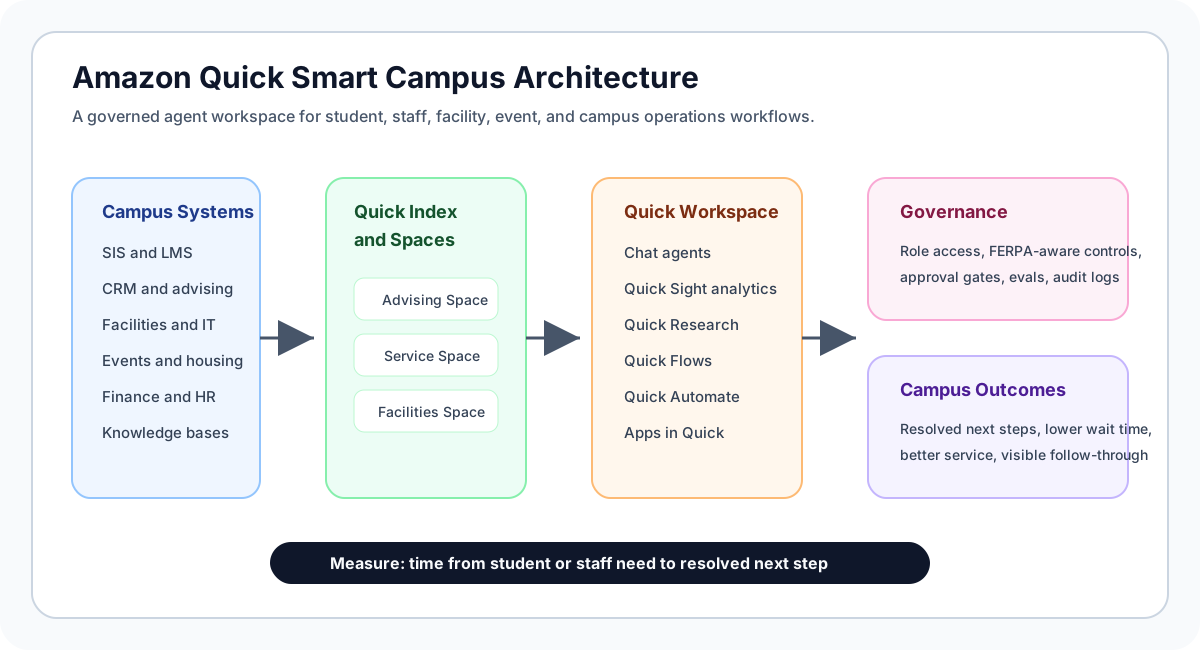
The architecture has five layers.
Campus systems. SIS, LMS, CRM, identity, HR, facilities, dining, parking, event calendars, access control, and knowledge bases remain the source of truth. The agent layer should not replace them.
Quick Index and Spaces. Spaces organize context for specific teams or workflows: advising, student services, facilities operations, public safety, advancement, research administration, and campus events. Quick Index grounds responses in approved documents and connected sources.
Quick Sight analytics. Dashboards and natural language analysis help teams understand trends: help-desk backlog, advising load, facility issue patterns, event attendance, financial aid bottlenecks, housing demand, or student service wait times.
Quick Flows and Quick Automate. Repetitive workflows become action paths. A student asks about a missed requirement, a staff agent checks the policy, drafts a response, opens a CRM task, and routes it to the right office if approval is needed.
Governance and human review. FERPA-aware permissions, role-based access, source citations, approval rules, evaluation datasets, and audit logs decide what an agent can see and do.
This is the difference between a campus chatbot and a smart campus operating layer.
High-Value Campus Workflows
The best first workflows share the same pattern: questions are frequent, context is spread across systems, and the next step is repeatable enough to bound with policy.
| Campus moment | What the agent does | Systems involved | Human owner |
|---|---|---|---|
| Advising preparation | Builds a pre-meeting brief with degree progress, risk signals, open holds, and recommended discussion points | SIS, LMS, degree audit, CRM | Advisor |
| Student service triage | Answers routine questions, checks status, drafts case notes, and routes exceptions | Knowledge base, CRM, finance, registrar | Student services lead |
| Facilities response | Groups work orders, prioritizes safety issues, drafts vendor notes, and reports recurring patterns | CMMS, maps, access, ticketing | Facilities manager |
| Event operations | Prepares runbooks, monitors attendance signals, flags staffing gaps, and drafts post-event reports | Calendar, ticketing, staffing, communications | Event operations |
| Campus safety support | Summarizes non-emergency incidents, routes follow-ups, and keeps records consistent | Dispatch logs, access events, case system | Public safety leadership |
| Research administration | Drafts sponsor summaries, compliance checklists, and task plans | Grant systems, policies, documents | Research admin |
Example: A Student Experience Agent
Imagine a student asks: "Can I still register for the data science practicum, and what do I need to fix first?"
A basic chatbot searches the catalog. A smart campus agent checks degree rules, registration dates, prerequisites, holds, advisor notes, course capacity, and relevant policy. It answers with sources and then prepares the action path: clear a hold, message the advisor, join the waitlist, or submit an exception request.
The workflow should be explicit:
workflow: student_registration_assist
trigger: student_question
space: advising_and_registration
agent_steps:
  - name: retrieve_policy
    sources: [catalog, registrar_policy, department_rules]
  - name: check_student_context
    tools: [sis_read, degree_audit_read, hold_status_read]
  - name: generate_plan
    output: sourced_next_steps
  - name: route_action
    rules:
      - if: financial_hold == true
        action: create_finance_task
      - if: prerequisite_exception_needed == true
        action: draft_advisor_request
      - if: course_capacity == "waitlist"
        action: prepare_waitlist_guidance
approval:
  required_for: [exception_request, policy_override, sensitive_disclosure]
audit:
  include: [sources, tools_used, student_context_ids, routed_actions]
The point is not to let an agent override policy. The point is to give the student a correct, sourced path and reduce the manual coordination required from staff.
Example: A Facilities Experience Agent
Smart campus experience also includes the physical campus. Broken HVAC in a lecture hall, inaccessible entrances, recurring Wi-Fi dead zones, and event setup issues all affect student trust. A facilities agent can group incoming tickets, compare them with building telemetry, identify repeat issues, and draft the work packet for the operations team.
type FacilitiesSignal = {
  building: string
  room?: string
  ticketType: "comfort" | "accessibility" | "safety" | "network" | "event"
  studentImpact: number
  recurrenceCount: number
  eventWithinHours?: number
}

function priorityScore(signal: FacilitiesSignal) {
  const safetyWeight = signal.ticketType === "safety" ? 40 : 0
  const accessibilityWeight = signal.ticketType === "accessibility" ? 30 : 0
  const eventWeight = signal.eventWithinHours && signal.eventWithinHours < 12 ? 20 : 0
  return signal.studentImpact * 8 + signal.recurrenceCount * 5 + safetyWeight + accessibilityWeight + eventWeight
}
This type of scoring should not replace dispatch judgment. It gives facilities teams a consistent way to see which work orders affect the campus experience most.
Governance for Campus Agents
Education data is sensitive. A smart campus agent may touch student records, financial information, disability accommodations, employment data, research materials, and security logs. That makes governance a first-class architecture requirement.
Every campus agent needs four controls.
Role-based access. The agent sees only what the user and workflow are allowed to see. An advising agent and a facilities agent should not share the same context window.
Source citation. Students and staff should see where an answer came from: catalog page, policy, course record, ticket, dashboard, or approved knowledge article.
Action approval. Agents can draft and route. Sensitive actions require approval: policy exceptions, financial decisions, conduct matters, safety escalation, or changes to student records.
Evaluation. Historical cases become test sets. The institution should know whether the agent routed correctly, cited the right policy, avoided unsupported claims, and escalated sensitive cases.
What Tactical Edge Builds
Tactical Edge helps institutions move from AI interest to production campus workflows using Amazon Quick and AWS-native controls.
| Workstream | Tactical Edge deliverable | Success measure |
|---|---|---|
| Campus workflow selection | Rank use cases by student value, staff load, data readiness, and risk | First workflow approved with measurable ROI |
| Quick setup | Spaces, agents, Quick Sight views, Flows, Automate paths, and Index configuration | Users can ask, analyze, and act in one workspace |
| Data and integration | SIS, LMS, CRM, facilities, knowledge base, and event connectors | Answers are grounded in approved campus sources |
| Governance | FERPA-aware access model, approval gates, logging, and eval cases | Sensitive actions route to humans |
| Launch and adoption | Pilot playbook, training, feedback loop, and operating dashboard | Reduced cycle time and improved service experience |
We usually recommend a 30-day campus agent pilot around one of four workflows: advising preparation, student service triage, facilities prioritization, or event operations. Each one creates a visible experience improvement without requiring a full campus transformation program.
The Smart Campus Metric That Matters
Smart campus programs often measure logins, app downloads, tickets closed, or dashboards viewed. Those are activity metrics. The better metric is time from student or staff need to resolved next step.
For advising, measure time from student question to accurate action plan. For facilities, measure time from issue report to prioritized work packet. For events, measure time from event request to approved runbook. For student services, measure time from inquiry to completed case or correct handoff.
Amazon Quick gives campuses a place where insight and action can meet. Agentic AI gives the workflow enough intelligence to coordinate across systems. Tactical Edge makes the architecture secure, measurable, and fit for the realities of higher education.
FAQ
Is this just a campus chatbot? No. A chatbot answers questions. A smart campus agent retrieves context, cites sources, prepares a next step, routes work, and records what happened.
Does Amazon Quick replace the SIS, LMS, or CRM? No. Quick sits above existing systems as an AI workspace for research, analytics, automation, and action. The systems of record stay in place.
Where should a campus start? Start with advising preparation, student service triage, facilities prioritization, or event operations. These workflows have frequent requests, distributed context, and clear human owners.
How do we protect student data? Use role-based Spaces, source permissions, approval gates, audit logs, and evaluation datasets. Agents should not see or act on data outside the approved user and workflow context.
The smart campus is not a bigger portal. It is a campus that can understand a need, gather context, recommend the next step, and move work to the right person or system with trust built in.