
Every enterprise I talk to has an AWS partner. Most of them chose that partner by counting badges on a website. Advanced Tier. Competency designations. Maybe a case study PDF with a suspiciously round ROI number. And almost none of them can tell me what that partnership actually delivers in the weeks between contract signing and production deployment.
Here is the uncomfortable truth: 97% of executives report personal productivity gains from AI tools, but only 29% see organizational ROI. That 68-point gap does not close because you picked the partner with the most logos. It closes because of things you cannot see on a slide deck: pre-production service access, co-engineering agreements with AWS service teams, and validated architecture patterns that compress your deployment timeline by months. The badge is a signal. The engineering underneath it is the value.
I have spent the last four years building agentic AI systems and cloud modernization platforms on AWS. What follows is an honest breakdown of what an AWS AI partnership actually delivers, what it does not, and how to tell the difference in a 30-minute evaluation call.
The Logo on the Slide Deck Isn't What You're Paying For
Most partner evaluations start and end with tier. AWS Select, Advanced, or Premier. The assumption is that higher tier equals better technical capability. That is wrong, or at least dangerously incomplete.
Tier reflects revenue commitment and customer success metrics. It tells you the partner has delivered a certain volume of AWS business. It does not tell you whether they have built production agentic AI systems, configured Bedrock guardrails under compliance constraints, or debugged a multi-agent orchestration chain at 3am when your Step Functions execution is looping.
The distinction that actually matters is whether the partner holds a Strategic Collaboration Agreement (SCA) with AWS. An SCA is a co-investment relationship. It unlocks joint go-to-market funding, dedicated AWS Solutions Architect resources assigned to the partner's accounts, and (critically) early access to services before general availability. At Tactical Edge, our SCA means we are building on Bedrock features while other consultancies are still reading launch blog posts.
The 97-to-29 gap, that chasm between individual AI excitement and organizational ROI, does not close with better models. It closes with better infrastructure, faster deployment, and architecture patterns that are already validated before your team writes the first line of code.
What a Strategic Collaboration Agreement Actually Gets You
An SCA is not a marketing arrangement. It is an engineering advantage with three concrete components.
Early service access. SCA partners typically get 60 to 90 days of access to new AWS services and features before GA. When Amazon Bedrock shipped new agent capabilities, we had already built production patterns, stress-tested token limits, and documented failure modes. Our clients deployed in weeks. Teams starting from GA documentation were still reading the API reference.
Dedicated AWS SA resources. Not the shared SA who covers 200 accounts. SCA partners get named Solutions Architects who understand the partner's reference architectures and can facilitate direct conversations with AWS service teams. When we hit a Bedrock Agents limitation during a financial services deployment, our dedicated SA got us a workaround from the service team in 48 hours. A standard support ticket would have taken two weeks minimum.
Escalation paths that bypass standard support. During critical production deployments, SCA partners can escalate directly to service team engineers. This is not a premium support perk you can buy. It is a relationship-level capability that exists because AWS has a financial and strategic interest in the partner's success.
Compare this with a non-partner consultancy: they work from public documentation, file standard support tickets, wait in queue, and build patterns from scratch every time. They may have brilliant engineers, but they are working with one hand tied behind their back.

The Architecture Review You Never Have to Schedule
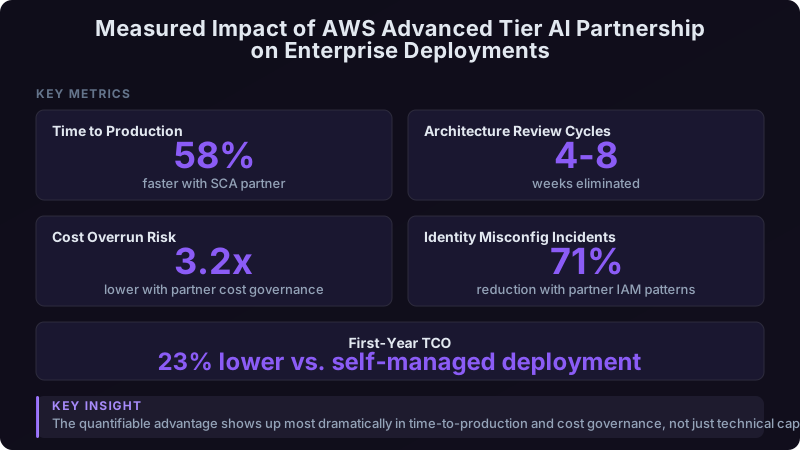
Every production AWS workload should go through a Well-Architected Framework review. In practice, these reviews take 4 to 8 weeks of back-and-forth between your team, the AWS SA, and (often) a third-party auditor for regulated industries.
Partner-validated architectures skip this cycle. When Tactical Edge deploys an agentic AI system on Bedrock with Step Functions orchestration, the architecture has already been reviewed and validated by AWS. The security patterns, IAM configurations, networking topology, and cost allocation tags are pre-approved. Your team inherits weeks of architectural due diligence on day one.
This matters even more with the MCP and A2A protocol stacks reaching production maturity. 42% of CTOs expect to run hybrid MCP plus A2A in production within 12 months. MCP handles the vertical integration (agent to tools), while A2A manages horizontal coordination (agent to agent). The reference architecture emerging, an orchestrator agent running an A2A coordination layer over specialist agents each wired to focused MCP server portfolios, requires precise AWS-native wiring across IAM, VPC endpoints, Lambda concurrency, and Bedrock model access policies. Generic consultancies miss these integration points because they have never deployed this pattern at scale.
| Milestone | SCA Partner | Internal Team | Generic Consultancy |
|---|---|---|---|
| Architecture Design | 1-2 weeks (pre-validated patterns) | 4-6 weeks | 3-5 weeks |
| Well-Architected Review | Skipped (pre-validated) | 4-8 weeks | 4-8 weeks |
| IAM & Identity Config | 1 week (templated policies) | 3-4 weeks | 2-3 weeks |
| Agent Orchestration (MCP/A2A) | 2-3 weeks | 6-10 weeks | 5-8 weeks |
| Production Deployment | 2-3 weeks | 4-6 weeks | 4-6 weeks |
| Total Timeline | 8-12 weeks | 20-30 weeks | 18-26 weeks |
The timeline compression is not a marketing claim. It is arithmetic: validated patterns eliminate review cycles, and early access means production-tested components instead of experimental ones.
Why Your AI Deployment Stalls at the Identity Layer
Here is a pattern I see in nearly every enterprise AI engagement: the team builds a working agent prototype in two weeks, then spends three months stuck on identity and access management.
The reason is identity dark matter. Every enterprise has fragmented service accounts, embedded credentials in legacy applications, and unmanaged API keys scattered across teams. In a traditional application, this is technical debt. In an agentic AI system, it is a live security incident waiting to happen.
79% of organizations report AI adoption challenges despite near-universal executive usage. The adoption challenge is not model quality. It is the governance infrastructure underneath, specifically the delegation chains that determine what an AI agent is authorized to do and on whose behalf.
Consider a multi-agent orchestration system where a planning agent delegates tasks to a research agent, which calls external APIs, queries a data lake, and writes results to S3. Each hop in that chain requires an IAM role assumption. The common shortcut is a broad IAM policy that grants the agent role full access to Bedrock, S3, and DynamoDB. This works in development and is a compliance violation in production.
AWS partner expertise with IAM, Lake Formation, and Bedrock guardrails means configuring least-privilege execution roles for each agent in the chain before the first line of business logic runs. We template these configurations from production deployments across regulated industries. Our IAM patterns for multi-agent orchestration have been validated across healthcare, financial services, and defense workloads. Your internal team would need to build these from scratch, and most will take the shortcut.
The sequencing matters: fix delegation sources (service accounts, embedded credentials) before implementing agent governance frameworks. Bolting governance onto broken identity foundations just creates a more expensive mess.
The Production Bottlenecks a Badge Won't Fix (But Engineering Will)
The gap between agentic AI demo and agentic AI production is wider than any previous ML deployment pattern. Five specific bottlenecks kill scale:
- Orchestration complexity: Multi-agent delegation chains with conditional branching, retry logic, and human-in-the-loop gates require Step Functions workflows that are an order of magnitude more complex than simple inference pipelines.
- Observability: Nested execution traces across agent chains need X-Ray tracing with custom subsegments, not just CloudWatch Logs. You need to trace a single user request through four agent hops and twelve tool calls.
- Evaluation at scale: There is no industry consensus on behavioral testing for agentic workflows. Human review does not scale. Automated evaluation requires custom harnesses built per use case.
- Cost control: One runaway agent workflow can consume thousands of dollars in hours. Without centralized gateways and per-workflow spending limits, your AI FinOps is guesswork.
- Safety governance: Autonomous actions need kill switches, approval gates, and audit trails that satisfy compliance frameworks like SOC 2 and HIPAA.
A revealing statistic: 5% of LLM calls report errors, and 60% of those errors are rate limit failures. This is not a model problem. This is immature production infrastructure: poor retry logic, missing queue buffers, and no request throttling.
Partner-grade monitoring differs from default setups in specifics, not abstractions. We deploy CloudWatch custom metrics for token consumption per agent, X-Ray trace maps that visualize the full agent delegation chain, and cost attribution dashboards that allocate spend to individual workflows, teams, and business outcomes. Default CloudWatch dashboards show you Lambda invocations. Our dashboards show you cost per customer interaction.
Building for Portability When 86% of CIOs Plan Cloud Exits
Cloud-first is giving way to cloud-appropriate. 86% of CIOs now plan workload moves from public cloud, and 80% expect to repatriate compute or storage within a year. If your AWS partner builds you into a corner, they are not a partner. They are a vendor.
A good AWS partner builds portable, not locked-in. This means containers over Lambda where workloads may move, open protocols (MCP, A2A) over proprietary integration patterns, and model-agnostic orchestration layers that can swap Bedrock for self-hosted models on EKS without rewriting business logic.
AWS itself now competes on portability. AWS Transform, introduced at re:Invent 2025, explicitly supports transitioning between AI vendors and open-source models. Portability is now a first-class capability within the AWS ecosystem, not an escape hatch built against it.
At Tactical Edge, we build our agentic AI systems with abstraction layers at three critical points: the model inference interface, the orchestration engine, and the data access layer. If a client decides to move inference from Bedrock to a self-hosted Llama model, only the inference adapter changes. The orchestration logic, tool integrations, and governance policies remain intact. This is not altruism. It is engineering discipline that protects the client's ability to negotiate from a position of strength.
The ability to exit a provider relationship is as strategically important as the ability to enter one. Your TCO models and contract negotiations improve dramatically when your architecture supports credible alternatives.
How to Evaluate an AWS AI Partner in 30 Minutes
Skip the capabilities presentation. Ask these seven questions instead:
- 1"How many Bedrock-based agentic systems are you running in production today?" The answer should be a number, not "several" or "multiple." If they hesitate, they are building demos, not production systems.
- 1"What is your standard IAM pattern for multi-agent orchestration?" They should describe role chaining, session policies, and scope-down policies. If they mention a single execution role, walk away.
- 1"Show me your cost attribution dashboard for an agentic AI workload." Not a CloudWatch default. A custom dashboard that allocates spend by workflow, agent, and business outcome.
- 1"What is your error budget for production agent systems?" They should have an answer. 99.5% availability with defined SLOs for agent response time and task completion rate is a reasonable baseline.
- 1"How do you handle model portability?" Listen for abstraction layers, not vendor-specific dependencies. They should mention container-based inference endpoints or model-agnostic APIs.
- 1"What was the last Bedrock feature you used in production before it hit GA?" This reveals whether they actually have early access or just claim it.
- 1"Describe a production incident with an agentic system and how you resolved it." Specific details (service, failure mode, root cause, fix) reveal real operational experience. Vague answers reveal marketing.
The partner who only discusses models and prompt engineering but never mentions IAM, networking, or cost governance is selling you a prototype, not a production system.
Here is your concrete next step: request a 30-minute architecture teardown of your current AI workload. Do not brief the partner in advance. Evaluate them by what they find, not what they present. A real partner will identify your identity dark matter, your cost attribution gaps, and your orchestration bottlenecks in the first meeting. If they spend 30 minutes showing you their slide deck instead, you have your answer.
That 68-point gap between personal AI wins and organizational ROI? It does not close with a better model or a bigger badge. It closes with engineering discipline applied at the identity layer, the cost governance layer, and the orchestration layer. Those are the layers where your partner choice actually matters.