
Most enterprises pick their AWS consulting partner the same way they pick a dentist: they ask a friend, skim a website, and hope for the best. The AWS partner badge on the homepage gets the same attention as the stock photo next to it. This is a mistake that costs real money and real time.
AWS restructured its partner program in 2024, tightening the requirements at every tier and creating hard gates that map directly to technical capabilities, support access, and funding eligibility. The badge is not a gold star for good behavior. It is a verifiable signal of how many certified architects are on staff, how many production workloads they have validated, and whether they can pick up the phone and get the right AWS engineer in a room with your team. If you are building enterprise AI workloads on AWS, the difference between a Select Tier partner and an Advanced Tier partner with a Strategic Collaboration Agreement is the difference between waiting five business days for an architecture review and getting one in 48 hours.
The Badge on the Website Isn't Just Marketing
Here is a scenario you have probably lived through. Your team is designing a multi-model inference pipeline on Amazon Bedrock. You hit a throughput ceiling you did not expect. Your consulting partner opens an AWS support ticket, and three days later you get a generic response pointing you to documentation you have already read. Meanwhile, your sprint is blocked and your stakeholders are asking why the demo is not ready.
Now imagine a different version. Your partner picks up the phone, calls their assigned Partner Solutions Architect at AWS, and within 48 hours you are on a call with the Bedrock product team discussing your specific token-per-second requirements and quota increases. That is not a hypothetical. That is the actual difference between partner tiers.
The 2024 restructuring introduced concrete, auditable requirements at each level. Registered partners complete basic training. Select Tier partners demonstrate a handful of certifications and customer launches. Advanced Tier partners pass a technical baseline review and maintain 20+ certifications with validated production architectures. These are not arbitrary thresholds. They represent the minimum investment AWS considers necessary for a partner to competently deliver at that level of complexity.
The Four AWS Partner Tiers, Stripped of the Jargon
AWS organizes its partner network into four tiers: Registered, Select, Advanced, and Premier. Each tier has specific, published requirements that go well beyond "pay a fee and show up."
Registered is the entry point. You complete the AWS Partner onboarding, get a few people through Cloud Practitioner certification, and you are in. There is no validation of delivery capability. This tier gives you access to the partner portal and basic training resources, but no funding programs and no dedicated AWS support relationship.
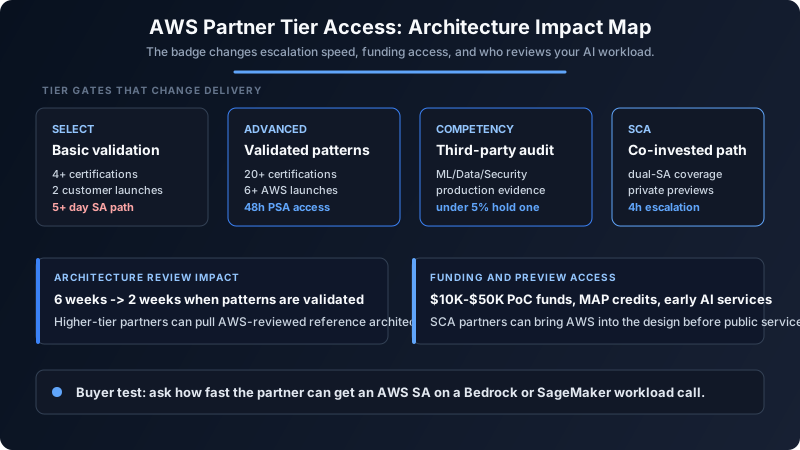
Select Tier requires a minimum of 4 AWS certifications (at least 2 at Associate level or above), 2 validated customer launches with documented architectures, and passing the AWS Technical Baseline Review. Select partners get access to limited Marketing Development Funds (MDF), typically $5K-$15K per quarter, and can register deal opportunities in AWS ACE (APN Customer Engagements).
Advanced Tier is where the gap widens significantly. Requirements include 20+ AWS certifications across the team (with a mix of Professional and Specialty), 6+ validated customer launches with reference architectures reviewed by AWS, and an annual minimum of $150K-$300K in AWS-influenced revenue (varies by region). Advanced partners get a dedicated Partner Solutions Architect, access to Migration Acceleration Program (MAP) credits for qualifying customer workloads, and Proof of Concept (PoC) funding that can cover $10K-$50K of a customer's prototyping costs.
Premier Tier is invite-only. AWS selects these partners based on $10M+ annual AWS-influenced revenue, deep specialization across multiple Competencies, and a track record of large-scale enterprise delivery. Premier partners get a dedicated Partner Development Manager, priority access to AWS service teams, and co-selling support from AWS field sales.
| Tier | Certifications Required | Validated Launches | AWS Funding Access | SA Escalation SLA |
|---|---|---|---|---|
| Registered | 2+ (Cloud Practitioner) | None | None | Community forums only |
| Select | 4+ (2 Associate+) | 2+ | MDF ($5K-$15K/quarter) | 5+ business days |
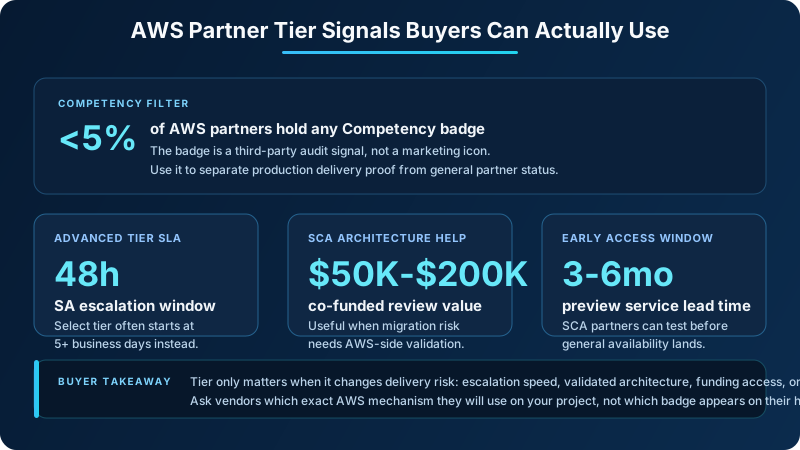
| Advanced | 20+ (Professional mix) | 6+ | MAP credits, PoC funds ($10K-$50K) | 48 hours |
| Premier (invite-only) | 50+ (Specialty required) | 20+ | Full co-investment programs | 24 hours, named SA |
Why Competency Badges Cost More Than You Think
If you have browsed the AWS Partner Directory, you have seen the Competency badges: Machine Learning, DevOps, Data & Analytics, Migration, Security, and more. These look like any other certification logo, but the process behind them is substantially more rigorous than most buyers realize.
Earning an AWS Competency requires passing an independent third-party audit. AWS contracts firms like Crispe (now part of Accenture's audit practice) to conduct these evaluations. The audit is not a questionnaire. Auditors review actual customer reference architectures, conduct live technical interviews with the partner's engineering team, and validate that production workloads are running as described. A partner claiming the Machine Learning Competency must demonstrate they have built and deployed SageMaker-based production pipelines (not just trained a model in a notebook and shown it in a demo).
Maintaining the Competency requires annual re-validation. Partners must submit new customer references and updated case studies each year. If your customer references go stale or your certified architects leave the company, you lose the badge. This is why fewer than 5% of AWS partners hold any Competency at all.
For you as a buyer, a Competency badge on a specific domain (say, ML or Data & Analytics) means the partner has been independently verified to deliver production-grade work in that area. It is the closest thing to a third-party technical due diligence report you can get without hiring your own auditors.
Strategic Collaboration Agreements: The Tier Nobody Explains
You will not find SCAs prominently featured on the AWS Partner Network website. They are not a tier in the traditional sense. They are bilateral investment agreements between AWS and a specific partner, committing both sides to joint go-to-market activities, technical co-development, and shared customer success metrics.
An SCA means AWS has agreed to co-invest in the partner's practice area. In practical terms, this unlocks co-funded architecture reviews where AWS covers 50-70% of the cost for qualified customer engagements. These reviews are not casual conversations. They are structured, multi-day engagements where an AWS Solutions Architect and the partner's architects jointly evaluate your workload against the Well-Architected Framework, with written findings and prioritized remediation plans. The value of a single review typically runs $50K-$200K depending on scope.
SCA partners also get access to private preview services. When AWS is preparing a new Bedrock model integration, a SageMaker feature, or an entirely new AI service, SCA partners see it 3-6 months before general availability. For customers, this means your partner can architect solutions around capabilities that are not yet public, giving you a head start on competitors who are working with publicly available services only.
For customers, the most immediate benefit of working with an SCA partner is dual-SA coverage. Your architecture gets reviewed by both the partner's Solutions Architect and an AWS Solutions Architect simultaneously. This eliminates the common failure mode where a partner designs something that technically works but does not align with how AWS recommends operating that service at scale.
Tactical Edge holds a Strategic Collaboration Agreement with AWS, which is how we deliver joint architecture reviews for enterprise AI workloads. Our team works alongside AWS SAs to validate multi-agent orchestration patterns, Bedrock integration architectures, and data platform designs before our customers commit to production builds.
How Partner Tier Maps to Your Architecture Decisions
Partner tier is not abstract. It directly affects how quickly your architecture decisions get validated and how much they cost.
Higher-tier partners maintain validated reference architectures on file with AWS. When you engage an Advanced Tier partner for a Well-Architected Review, they can pull from pre-approved patterns for common workloads. This reduces the review cycle from a typical 6 weeks (for a partner starting from scratch) to roughly 2 weeks. The difference is not speed for speed's sake. It is the difference between validating your architecture before sprint 3 versus discovering issues in sprint 8.
Advanced and Premier partners can request AWS service team calls for your specific workload. This is not "call AWS support." This is getting the actual product team for Bedrock, SageMaker, or EKS on a call to discuss your throughput requirements, your multi-tenant isolation needs, or your cost optimization questions. Select Tier partners cannot do this. They go through the same support channels you have access to with Enterprise Support.
Credit programs illustrate the gap clearly. If you are migrating workloads to AWS, the Migration Acceleration Program (MAP) provides credits that can cover 15-25% of your first-year AWS spend. Select Tier partners cannot nominate you for MAP. Only Advanced and above can submit the nomination, and SCA partners typically have faster approval cycles because AWS has already invested in their pipeline.
Your partner's tier also determines your TAM (Technical Account Manager) relationship. Complex multi-account deployments for AI workloads (think separate accounts for training, inference, data lake, and governance) benefit enormously from a dedicated TAM who understands your full architecture. Higher-tier partners can facilitate dedicated TAM assignments rather than shared ones.
The Support Escalation Path You Don't See
It is 2am. Your AI inference endpoint is throwing throttling errors. Customers are seeing degraded response times. Your on-call engineer has exhausted the standard troubleshooting steps.
What happens next depends entirely on your partner's tier.
If your partner is at Select Tier, they open a support case through the normal AWS Support channel. Even with Enterprise Support, a Sev-2 case during off-hours typically takes 12-72 hours to reach a specialist who understands your specific service configuration. Your partner has no dedicated contact at AWS to escalate to.
If your partner is at Advanced Tier, they have a Partner Solutions Architect assigned by vertical (financial services, healthcare, manufacturing). That PSA can be reached directly and can escalate within AWS on your behalf, bypassing the general queue. Typical resolution path: 8-24 hours.
If your partner holds an SCA, they can trigger a joint escalation path. This is a shared war room model where AWS support engineering, the partner's architects, and your team collaborate in a single channel. We have seen SCA-backed escalations for SageMaker endpoint scaling issues resolve in 4 hours. The same issue through standard Enterprise Support alone was estimated at 72 hours.
What to Ask Your AWS Partner Before Signing
Five questions will separate partners who can actually deliver from partners who just have a nice website:
- 1"What is your current AWS Partner tier, and when was it last validated?" Tiers are re-evaluated annually. A partner who was Advanced in 2023 may have dropped to Select if they lost certified staff or did not submit new customer launches.
- 1"Which AWS Competencies do you hold, and in what domains?" If you are building GenAI applications, you want the Machine Learning Competency. If you are modernizing a data platform, you want Data & Analytics. Generic "we do everything" answers are a red flag.
- 1"Do you hold a Strategic Collaboration Agreement with AWS?" If yes, ask what it covers. SCAs are domain-specific. An SCA focused on migration does not help you with AI workloads.
- 1"How many Solutions Architects on your current team hold AWS Professional or Specialty certifications?" Five architects with Solutions Architect Professional certs are dramatically more useful than 20 people with Cloud Practitioner badges. The Professional and Specialty exams test production architecture skills, not terminology recall.
- 1"Can you share your three most recent AWS-validated customer launches in our workload category?" Validated means AWS reviewed and approved the architecture. If they cannot name three, they either do not have them or they were in a different domain than what you need.
Additionally, ask whether they can nominate you for MAP credits or PoC funding and what the typical approval timeline looks like. Advanced partners with active AWS relationships can often get PoC funding approved in 2-3 weeks. Partners without those relationships may take 8-12 weeks or be unable to access the programs at all.
Picking the Right Partner for Enterprise AI Workloads
For production GenAI workloads, the minimum viable partner profile is clear: Advanced Tier with the Machine Learning Competency and proven Bedrock or SageMaker deployments in production (not demos, not prototypes, production). If you are building multi-agent systems or complex orchestration pipelines, an SCA with AI/ML focus is not optional, it is the access layer that determines whether you can get early visibility into new capabilities and fast resolution when things break.
Here is a single metric to track this week: measure how many hours it takes your current partner to get an AWS Solutions Architect on a call about a specific workload question. Not a generic check-in. A call where you can ask, "We are hitting 350ms p99 latency on Bedrock Claude invocations with 8K token inputs, and we need to understand if this is a quota issue or an architectural one." Time the response. If it takes more than 48 hours, your partner's tier is limiting your velocity.
Partner tier is not a perfect proxy for engineering quality. A brilliant two-person consultancy at Select Tier can out-architect a mediocre Advanced Tier firm. But tier is an excellent proxy for access, and access determines how fast your architecture decisions get validated, how quickly escalations resolve, and whether you can tap into funding programs that reduce your cloud spend by six figures.
The badge on the website is not a vanity metric. It represents audited technical capabilities, gated support access, and contracted investment from AWS. When your inference pipeline is down at 2am, you will care very much about what that badge actually means. Start asking the five questions above before your next partner engagement, and track that SA-response-time metric this week. The number will tell you everything you need to know.