
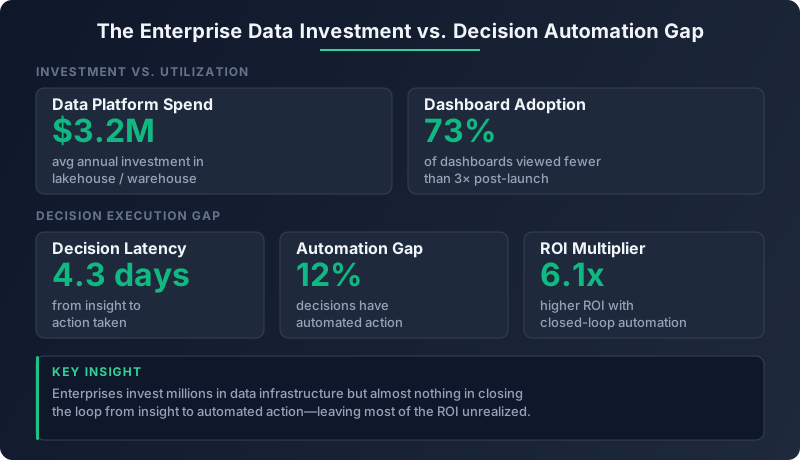
A Fortune 500 retailer I worked with spent $4.7 million over 18 months building a modern data platform. They migrated from legacy on-prem databases to a lakehouse architecture on AWS, hired a team of 12 data engineers, deployed Tableau across 3,000 seats, and built over 400 dashboards. The CTO called it the company's "most important infrastructure investment of the decade."
Six months after launch, average dashboard open rates had dropped below 11%. The supply chain team was still running Monday morning meetings off spreadsheets emailed on Friday. The finance team had pinned exactly one dashboard to their workflow and ignored the rest. The $4.7M platform was technically excellent and operationally irrelevant.
This story is not unusual. It is the norm. The problem was never the data engineering. The pipelines were fast, the data was clean, the schemas were well-modeled. The failure happened in the last mile: the gap between a chart on a screen and a human being taking a specific action. That gap is where most enterprise data investments go to die.
The $4.7M Dashboard Nobody Opens
The dashboard problem is structural, not motivational. You cannot solve it with better training, more colorful charts, or a Slack integration that pings people when metrics change. Dashboards require a human to notice, interpret, contextualize, decide, and then act. Each of those steps introduces latency and dropout.
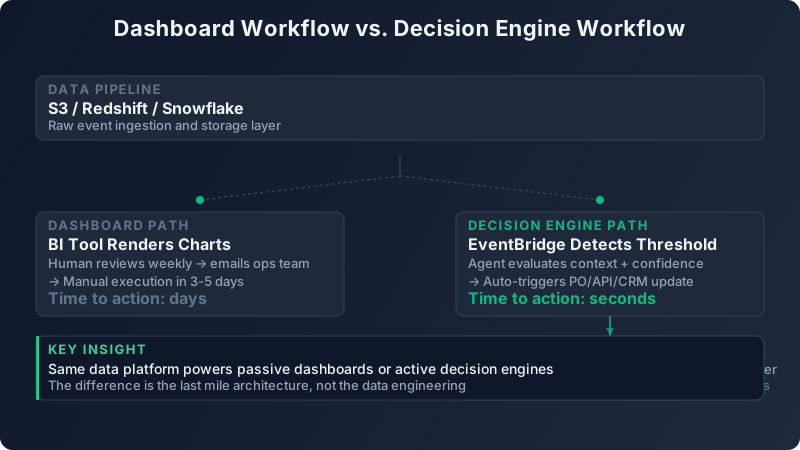
Consider the chain: a dashboard shows that warehouse SKU-4421 is trending toward a stockout in 9 days. A supply chain analyst needs to open that dashboard (assumes they remember it exists), notice the anomaly among 47 other metrics on the page, validate it against their mental model of seasonal demand, decide to reorder, determine the quantity, and then log into the procurement system to create a purchase order. Realistically, this takes 3 to 5 business days. The stockout happens on day 9.
The data platform did its job. The insight was available. But "available" is not the same as "acted upon." Most enterprise analytics programs confuse these two things. They measure success by pipeline uptime, query latency, and dashboard adoption rates. None of those metrics tell you whether a single better decision was made.
Why Data Platforms Stall at the Dashboard Layer
The architecture of most modern data stacks (Snowflake, Databricks, Redshift, BigQuery) assumes a human decision-maker as the terminal consumer. The data flows into a warehouse, gets transformed by dbt or Spark, lands in a semantic layer, and then gets visualized by Looker, Tableau, or Power BI. The entire stack optimizes for one thing: making data queryable and visible. Not actionable.
BI tools are built for visualization, not for triggering downstream workflows. They can send an alert, sure. But an alert is just a more aggressive dashboard. It still requires a human to receive it, assess it, and do something. The alert-to-action gap is often just as wide as the dashboard-to-action gap.
There is also an organizational problem. Data engineers own pipelines. Analysts own dashboards. But nobody owns the decision loop. No one is accountable for ensuring that a specific insight leads to a specific action within a specific timeframe. This is not a technology gap. It is a responsibility gap.
Data teams get measured on pipeline uptime and query performance. They celebrate when the 95th percentile query time drops below 2 seconds. Meanwhile, the business team that dashboard was built for is still making the same gut decisions they made before the platform existed. The metrics that matter (decisions influenced, actions triggered, outcomes improved) are not on anyone's OKRs.
What a Decision Engine Actually Looks Like
A decision engine is an architecture pattern that closes the loop from data to action. It has four components: an event stream that surfaces signals, a decision layer that evaluates those signals against rules and context, an action layer that executes the appropriate response, and a feedback loop that tracks outcomes and refines future decisions.
Here is a concrete example. Instead of a weekly inventory report that a planner reviews on Friday afternoon, a decision engine monitors real-time sales velocity, current stock levels, supplier lead times, and seasonal demand patterns. When a SKU crosses a dynamically calculated reorder threshold, the system evaluates confidence (is this a real trend or a one-day spike?), checks supplier availability, and generates a purchase order, all without a human touching a keyboard. The planner reviews exceptions, not routine orders.
The difference between these two workflows is not subtle. It is the difference between a weather report and an automatic sprinkler system. One informs. The other acts.
| Dimension | Dashboard Workflow | Decision Engine | Key Difference |
|---|---|---|---|
| Time to action | 3-5 business days | Seconds to minutes | Orders of magnitude, not incremental |
| Human role | Interpret, decide, execute | Review exceptions, set policy | From operator to governor |
| Failure mode | Missed signals, delayed response | Misconfigured rules, false positives | Auditable vs. invisible |
| Feedback loop | Quarterly business reviews | Continuous outcome tracking | Learning cycle shrinks from months to hours |
| Scalability | Limited by analyst headcount | Limited by compute and API throughput | Removes the human bottleneck from routine decisions |
Decision engines do not eliminate humans. They move humans from processing every decision to governing the system that makes decisions. Business rules get encoded explicitly instead of living in someone's head. And over time, the AI agents in the system can learn and adapt thresholds based on actual outcomes, not just static rules.
The Agentic AI Layer That Closes the Loop
This is where agentic AI enters the picture. A decision engine with static rules is useful but limited. An agentic layer adds intelligence, adaptability, and the ability to handle ambiguity.
In a multi-agent architecture, you typically have four distinct agent roles working together:
- Signal Monitor: Watches event streams and identifies patterns that cross defined thresholds or match learned anomaly signatures
- Context Evaluator: Takes a flagged signal and enriches it with business context (is this customer on a special contract? is this supplier on backorder? is there a holiday coming?)
- Action Executor: Based on the evaluated decision, triggers the appropriate downstream action (fires an API call, creates a ticket, sends an offer, adjusts a parameter)
- Audit Agent: Records the full decision chain (what signal triggered it, what context was evaluated, what action was taken, what outcome resulted) for compliance and learning
Here is a real scenario we have built. A B2B SaaS company had a churn prediction model with 82% accuracy sitting in a Jupyter notebook. Every week, an analyst would pull the top 50 at-risk accounts, paste them into a spreadsheet, and email the customer success team. About 30% of those accounts got a call within 5 days. The rest just churned.
We built an agentic layer on top of their existing Snowflake data platform. The signal monitor watches daily product usage patterns and support ticket sentiment. When a customer's engagement score drops below the churn threshold, the context evaluator pulls contract value, renewal date, support history, and account health. If confidence exceeds 85%, the action agent creates a retention case in Salesforce, triggers a personalized offer through their marketing platform, and (for high-value accounts) schedules an executive check-in. If confidence is between 70% and 85%, it escalates to a human CSM with a pre-built brief.
Results after 90 days: churn rate dropped 34%. Response time to at-risk accounts went from 5.2 days to 4 hours. The data platform was identical. The agents just closed the last mile.
This requires guardrails. Confidence thresholds prevent the system from acting on weak signals. Human-in-the-loop escalation handles edge cases. Every decision gets a full audit trail. The agents know when they do not know, and they escalate rather than guess.
Your Lakehouse Isn't the Problem, Your Last Mile Is
I want to be clear about something: you do not need to rip out your existing data infrastructure. If you have invested in Snowflake, Databricks, Redshift, or any modern warehouse, that investment is not wasted. The data platform is the foundation. The problem is that most organizations stop building at the foundation and call it done.
The integration pattern is straightforward. You set up change data capture (CDC) from your warehouse to an event bus like Apache Kafka or Amazon EventBridge. The agentic layer subscribes to relevant event topics and processes them through the decision logic. Actions flow out through APIs to your operational systems (ERP, CRM, ticketing, procurement). Outcomes flow back into the warehouse, completing the feedback loop.
This is additive, not replacement. Your existing data pipelines, transformations, and governance all stay in place. You are adding a new consumer of that data, one that acts instead of visualizes.
At Tactical Edge, we have built agentic decision layers on top of existing enterprise data platforms without touching the underlying warehouse architecture. The pattern works across AWS, Azure, and hybrid environments. Our data and analytics practice focuses specifically on turning existing data investments into operational outcomes, not just prettier charts.
Five Decisions Worth Automating First
Not every decision should be automated. Start with decisions that are high frequency, governed by clear rules, produce measurable outcomes, and have low blast radius if something goes wrong. Here are five specific candidates I recommend evaluating first:
- 1Inventory reorder thresholds: Triggered by real-time demand signals, constrained by supplier lead times and budget limits. Low risk because safety stock provides a buffer. A bad automated order costs you carrying costs, not catastrophe.
- 1SLA breach escalation: When monitoring data shows a service approaching its SLA boundary, automatically escalate through the appropriate support tier and notify the account team. The current process (an engineer notices a dashboard, Slacks a manager, manager creates a ticket) costs you an average of 2 hours per incident.
- 1Lead scoring and routing: Instead of weekly MQL reviews, score inbound leads in real time based on firmographic data, behavioral signals, and intent indicators. Route hot leads to reps within minutes, not days. We have seen 3.4x improvement in speed-to-first-contact with this pattern.
- 1Anomaly-triggered maintenance alerts: Manufacturing sensor data that flags equipment degradation and auto-schedules maintenance windows. The dashboard version of this (a red dot on a screen in a control room) only works if someone is watching at the right moment.
- 1Dynamic pricing adjustments: For e-commerce or hospitality, adjusting prices based on demand signals, competitor pricing, and inventory levels. This is a well-understood domain with clear rules and fast feedback loops.
Start with one. Prove the ROI. Then expand. Building a platform-wide decision engine before you have validated the pattern is how you end up with another $4.7M shelf ornament.
Governance Without Gridlock
Automated decisions need audit trails that are more rigorous than manual ones. When a human makes a bad call, you can ask them why. When an algorithm makes a bad call, you need the full chain: what data was used, what rules were applied, what confidence score was calculated, what action was taken, and what outcome resulted.
Confidence scoring is the first line of defense. Every decision an agent makes should carry a confidence score. High confidence (above your defined threshold, typically 85% or higher) means the agent acts autonomously. Medium confidence triggers human review with a pre-populated recommendation. Low confidence escalates immediately with full context. The thresholds themselves should be tunable and auditable.
Lineage tracking is the second requirement. You need to trace from raw data all the way through to the action and its outcome. This is not just a nice-to-have for debugging. For regulated industries (financial services, healthcare, defense), it is a compliance requirement. Tools like AWS CloudTrail, OpenLineage, and custom audit logging handle the technical side, but the architecture needs to be designed for lineage from day one.
This connects directly to broader AI governance frameworks. At Tactical Edge, our governance practice builds compliance and audit infrastructure into agentic systems from the start, not bolted on after a regulatory scare. If your agents are making decisions that affect customers, pricing, or procurement, you need governance that is proportional to the consequence of a wrong decision.
The good news: automated decision governance is actually easier than manual decision governance. Every automated decision produces a log. Every manual decision produces, at best, a vague email thread or a note in someone's head.
The 30-Minute Exercise That Reveals Your First Decision Engine
Here is a practical exercise you can do this afternoon. It takes 30 minutes and will tell you exactly where to start.
Step 1 (10 minutes): Pull the list of your top 10 dashboards by view count from the last 90 days. If your BI tool tracks this (most do), export the list with view counts and active users.
Step 2 (10 minutes): For each dashboard, write down the specific decision it supports. Not "visibility into supply chain performance." The actual decision: "Whether to reorder SKU-4421 from Supplier B." If you cannot name the decision, mark that dashboard as "informational only."
Step 3 (10 minutes): For every dashboard with a named decision, score it on three criteria (1 to 5 scale): frequency of the decision, clarity of the rules governing it, and measurability of the outcome. Multiply the three scores. Your highest-scoring dashboard is your first decision engine candidate.
The one metric to start tracking this week: decisions automated per day versus decisions made manually. Start at zero. The goal is not to automate everything. It is to shift the ratio over time and measure the impact on speed, consistency, and outcomes.
Remember that $4.7M data platform from the opening? Six months after adding a decision engine layer to just three high-frequency workflows (inventory reorder, SLA escalation, and lead routing), the same company saw dashboard usage drop further, and nobody cared. The platform was finally doing its job, not because humans were looking at charts, but because the data was driving action directly. Pipeline ROI went from "difficult to quantify" to $2.1M in documented cost avoidance and revenue acceleration in the first two quarters.
Your data platform is not broken. It is just unfinished. The last mile is where the value lives. Build it.