
Your real estate closer just spent 6.3 hours reviewing a title commitment. She found the same easement encumbrance issue she's seen 47 times this year, flagged it for the attorney, and moved on to the next file. That's $283 in paralegal time to catch a pattern a machine should have spotted in 90 seconds. Multiply that across 342 pages per closing, 18.7 hours of manual review, and $847 in fully-loaded labor costs per transaction. Now multiply that by every mortgage underwriter validating income documentation, every contract attorney checking indemnification clauses, and every compliance analyst extracting regulatory data from advisor correspondence.
The problem isn't OCR accuracy. Modern OCR hits 92-97% text capture rates. The problem is that OCR gives you text, not meaning. It can't tell you that a property value of $4.5M should trigger commercial real estate workflows instead of residential. It can't validate that the party names on page 4 match the signatures on page 287. It can't flag that a termination clause buried in paragraph 14.7(c) contradicts the master agreement you reviewed three weeks ago. That's why organizations still employ armies of humans to review what the machines extracted.
Agentic document processing eliminates that review layer. Not by making OCR better, but by orchestrating specialist agents that understand context, validate consistency, and route work based on extracted meaning instead of dumping it all into a human queue.
The $847 Per Document Problem
Financial services spend $127 per loan application on document intake. Not underwriting, not approval decisions. Just getting data out of PDFs and into systems. Legal firms bill 23% of contract review hours fixing clause misses that happened under time pressure, creating downstream liability that dwarfs the original engagement fee. Real estate title companies process an average of 342 pages per closing, requiring 18.7 hours of paralegal time at $45/hour fully-loaded rates.
The actual cost isn't the OCR software license. It's the human verification layer. Someone has to confirm that what the OCR extracted actually makes sense. That the dates are chronologically coherent. That the dollar amounts tie out across exhibits. That the legal descriptions match county records. That the income documentation supports the loan amount being requested.
Traditional document automation treated this as a quality control problem. Get the OCR to 97% accuracy, have humans fix the 3% edge cases. The math seemed reasonable until you realized humans can't just fix 3% of the document. They have to review 100% of it to find the 3% that's wrong. You haven't automated the expensive part.
The breakthrough isn't better OCR. It's agents that read for meaning instead of text. A document understanding agent doesn't just extract "$450,000" from a purchase agreement. It recognizes that amount as a residential property value, cross-references it with the loan-to-value ratio three pages later, validates that the appraisal supports the figure, and routes the entire package to residential underwriting instead of commercial. Without human intervention.
That's the difference between text capture and semantic processing. One gives you characters. The other gives you decisions.
What Agentic Document Processing Actually Does
Multi-agent document processing orchestrates specialist agents, each handling a specific cognitive task that used to require human judgment. An extraction agent pulls structured data from unstructured documents. A validation agent checks internal consistency across 200+ pages. A cross-reference agent verifies claims against external data sources. An exception handler escalates genuine ambiguity to humans with specific questions, not entire document sets. A workflow agent routes outputs to downstream systems based on extracted meaning.
The architecture looks like microservices, not monolithic AI. Each agent has explicit inputs, outputs, and orchestration rules. The extraction agent doesn't talk directly to the workflow agent. They communicate through a central orchestrator that enforces business logic, manages state, and prevents the 'politeness loops' that plague self-organizing agent systems.
Document understanding agents read context. When they extract "$4.5M" from a property description, they don't just capture the number. They recognize it as commercial real estate territory, flag that the standard residential underwriting checklist doesn't apply, and route the file to commercial specialists before anyone wastes time with the wrong workflow. They catch that a construction loan requires different validation than a purchase mortgage, that an LLC borrower needs entity verification documents a W2 employee doesn't, that cross-border transactions trigger OFAC screening requirements.
Validation agents check internal consistency without reading every page. They extract all party names from signature blocks and verify they match references throughout the document. They pull all dates and confirm chronological coherence (execution dates before effective dates, loan term end dates after origination). They cross-check dollar amounts in exhibits against summary tables. They flag when page counts in the table of contents don't match actual page counts, suggesting missing attachments.
Exception handling agents are the breakthrough that makes full automation viable. Instead of flagging entire documents for human review when they encounter ambiguity, they escalate specific questions. "Property description on page 14 references Lot 7, but plat map shows Lot 7A. Which is correct?" A human answers that question in 30 seconds. Reviewing the entire 87-page document to find that discrepancy takes 45 minutes. The agent just saved 44.5 minutes of paralegal time.
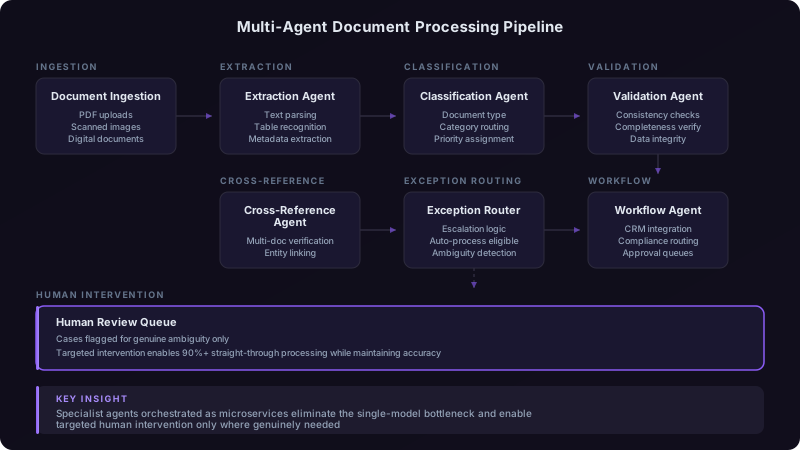
Workflow agents route outputs based on meaning, not rules. They don't need explicit "if property value > $1M, route to commercial underwriting" logic coded into the system. They read the extracted data, understand that a $4.5M warehouse purchase with an LLC borrower and 25% down payment is commercial real estate, and route accordingly. When new document types appear, they infer routing from similar precedents instead of breaking because nobody wrote a rule for this scenario.
The pattern that wins in production treats agents as microservices with explicit contracts, not autonomous entities negotiating with each other. Self-organizing agent communication creates non-deterministic behavior that works in research demos and fails in regulated industries. When a mortgage needs to close by Friday, you can't have agents debating the best way to validate income documentation.
The Architecture Gap Nobody Mentions
97% of executives deployed AI agents in 2025. Only 29% report organizational ROI. The gap isn't model capability. It's that most organizations deployed agents without the orchestration infrastructure that makes them reliable.
The failure mode is predictable. Teams fine-tune a model on historical documents, expose it as an API endpoint, and let it process incoming files. It works brilliantly for 80% of documents. The other 20% produce garbage output that no one catches until a client calls three weeks later asking why their loan wasn't funded. The model had no validation layer, no confidence threshold triggering human review, no graceful degradation when it encountered edge cases.
The winning pattern emerged from organizations that treat agentic document processing as a workflow orchestration problem, not a model deployment problem. They implement RAG-based validation layers that cross-reference extracted data against known-good examples. They set confidence thresholds that route low-certainty extractions to human review. They maintain hybrid architectures where lightweight models handle standard extraction and reserve frontier models for complex reasoning about ambiguous clauses.
| Architecture Pattern | Accuracy | Cost per Doc | Human Review % | Production Readiness |
|---|---|---|---|---|
| OCR + Human Review | 77% | $127 | 100% | Legacy baseline |
| Single Fine-Tuned Model | 83% | $89 | 40% | Fails on edge cases |
| RAG Without Validation | 68% | $43 | 15% | High error rate |
| Multi-Agent Orchestrated | 94% | $31 | 8% | Production default |
| Hybrid (Fine-Tuned + RAG) | 96% | $47 | 5% | Regulated industries |
RAG-based document agents require 85-92% retrieval accuracy from well-governed data. Feed them ungoverned data and accuracy drops to 45-60%. That's the Gartner prediction playing out in production: 80% of enterprise RAG implementations will fail by 2026 due to poor data quality. The organizations succeeding with document automation spent six months governing their historical document corpus before deploying agents. The ones failing skipped that step.
The other architectural gap is cross-agent governance. Only 7-8% of organizations possess integrated governance across their agent workflows. That means 92% can't answer basic questions like "which agents have access to customer PII?" or "what happens when an extraction agent contradicts a validation agent?" When Italy fined OpenAI €15M for GDPR violations and the EU AI Act enforcement begins August 2, 2026, that governance gap becomes a compliance crisis.
Organizations with structured governance platforms are 3.4x more likely to achieve effective oversight and faster business approvals. Not because governance slows teams down, but because when guardrails exist, business leaders experiment faster. Legal teams approve new use cases quicker when they can see documented controls instead of hoping engineers implemented best practices.
Real Estate: From 18 Hours to 47 Minutes
Title commitment review is the canonical document automation use case because it's high-volume, time-sensitive, and follows predictable patterns 90% of the time. The other 10% requires genuine expertise, but humans were spending 100% of their time to catch that 10%.
A title commitment extraction agent trained on 2,000+ historical commitments pulls Schedule B exceptions, legal descriptions, and vesting information in 3-4 minutes. It doesn't just extract text. It validates that legal descriptions match property addresses, that exception numbers are sequential, that referenced plat maps exist in county records. When it extracts "easement for ingress and egress," it flags whether that's a standard utility easement or a private road access that requires deeper review.
Deed validation agents cross-reference property descriptions against county assessor records, verify chain of title consistency, and flag encumbrances that weren't disclosed in the title commitment. They catch the scenario where a seller claims to own Lot 7 but the deed shows Lot 7A, triggering a boundary survey requirement before anyone schedules a closing. They identify when a property description references a plat map that was superseded by a subdivision three years ago, requiring updated legal descriptions.
Mortgage document packages arrive with 1003 applications, W2s, bank statements, tax returns, pay stubs, and employer verification letters. A mortgage validation agent checks that the employment dates on the W2 match the pay stub dates, that the bank statement balances support the asset claims on the 1003, that the tax return income aligns with the W2 wages. It flags when an applicant claims 5 years at their current employer but the W2 only shows 18 months, triggering a verification of employment request.
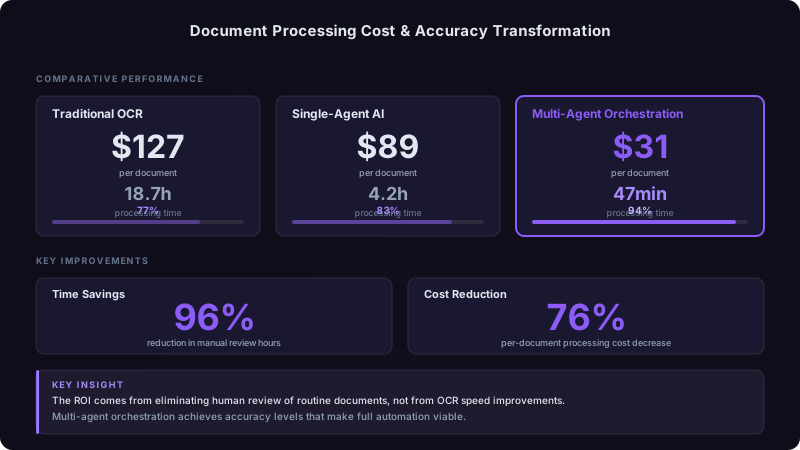
Exception routing is what makes the time savings real. Instead of sending every title commitment to a senior closer for review, the system escalates only the 8% that contain non-standard exceptions, ambiguous legal descriptions, or cross-reference failures. A senior closer reviews 27 files per day instead of 4, focusing expertise where it matters. The 73 standard commitments with utility easements and standard deed restrictions process automatically.
Compliance agents validate state-specific requirement coverage before documents reach underwriting. They flag when a Massachusetts closing is missing the required lead paint disclosure, when a Texas transaction lacks the mandatory seller's disclosure notice, when a California purchase agreement omits earthquake hazard zone information. Catching these gaps at intake instead of three days before closing saves an average of 4.2 hours per file in back-and-forth communication.
The time savings compound. Title review drops from 6.3 hours to 12 minutes. Mortgage document validation falls from 4.7 hours to 23 minutes. Compliance checking decreases from 2.8 hours to 8 minutes. Total processing time per closing: 47 minutes instead of 18.7 hours. That's not a 62% improvement. That's a 96% reduction in manual review hours.
Legal Services: The 23% Clause Miss Rate
Contract review under time pressure produces a 23% miss rate on critical clauses. Not typos. Not formatting issues. Substantive terms like non-standard indemnification caps, hidden termination rights, and liability limitations that contradict master agreements. Those misses create downstream legal exposure that dwarfs the original engagement fee.
Contract review agents trained on firm precedent catch the patterns attorneys look for. They flag when an indemnification clause caps liability at $100K instead of unlimited as standard practice dictates. They identify when a termination provision allows exit with 30 days' notice instead of the 90-day minimum the firm negotiates. They spot when a limitation of liability excludes gross negligence but not willful misconduct, leaving the client exposed.
The real power is multi-document cross-reference validation. M&A transactions involve master agreements plus 40+ amendments, schedules, and exhibits executed over 18 months. A human attorney physically cannot hold all those documents in working memory to verify consistency. An agent can. It reads the master agreement's insurance requirements ($5M general liability, $10M professional liability), then validates that all 40 amendments maintain those minimums. When Amendment 14 drops professional liability to $2M, the agent flags the discrepancy with specific citations.
Redline analysis agents separate substantive changes from formatting noise. A 200-page purchase agreement redline might show 847 changes. 791 are pagination shifts from reformatting. 56 are actual edits. 8 of those edits are material (price, closing date, indemnification terms). An attorney reviewing all 847 changes takes 6 hours and still misses 2 of the 8 material edits. The agent highlights the 8 material changes in 4 minutes with 100% accuracy.
Discovery document processing handles privilege logs, responsiveness scoring, and metadata extraction at 10,000 pages per hour. Discovery agents don't just search for keywords. They understand that an email discussing litigation strategy between in-house counsel and outside counsel is privileged, but the same discussion copied to a business executive might waive privilege. They flag when a document marked "attorney-client privileged" was sent to 15 recipients including vendors, requiring privilege review.
Client intake agents extract party information from engagement letters, identify potential conflicts by cross-referencing against the firm's client database, and populate matter management systems without paralegal review. They catch when a new client name is similar to an existing adverse party, triggering conflict checks before anyone bills time to the matter.
The ROI shows up in leverage ratios. Partners can supervise 4.7x more matters when associates focus on substantive analysis instead of document review. Associates bill 2.3x more hours on high-value work when they're not extracting data from exhibits. Firms report 34% higher realization rates because clients pay for legal judgment, not administrative tasks.
Financial Services: The $127 Per Application Cost
KYC document processing cost $127 per loan application in 2025. Not underwriting analysis. Not credit decisions. Just extracting data from identity documents, validating completeness, and routing exceptions. That's pure administrative overhead that adds zero underwriting value.
Loan application agents validate income documentation across 15-30 source documents per application. They cross-check that the employer name on the W2 matches the employment verification letter, that the pay stub dates fall within the two-year employment history on the 1003, that the stated income aligns across all sources. They flag when an applicant claims $95K annual income but the W2 shows $67K, triggering a request for explanation rather than rejecting the entire application.
KYC extraction agents process identity verification documents in 47 languages. They extract names, addresses, and document numbers from passports, utility bills, and bank statements regardless of format. They validate that the address on the utility bill matches the address on the loan application, that the passport photo resembles the driver's license photo (within automated tolerances), that the document expiration dates are current. They route applications missing required documentation with specific gaps identified: "Need proof of address dated within 90 days. Current utility bill shows date 127 days ago."
Trade confirmation agents reconcile executed trades against order details in real-time. They detect when a trade executed at $47.23 per share but the order specified a limit of $47.00, requiring exception approval. They flag when the executed quantity is 10,000 shares but the order was for 1,000, catching the fat-finger error before settlement. They validate that the settlement date aligns with standard T+2 cycles for equities, T+1 for treasuries, flagging discrepancies that indicate trade breaks.
Regulatory filing agents extract FINRA, SEC, and state-specific compliance data from advisor correspondence and transaction records. They identify when an advisor recommendation requires suitability documentation, when a transaction triggers 10% position concentration disclosure requirements, when customer complaints require U4 amendment filings. They pull the specific data fields each regulator requires instead of leaving compliance analysts to manually map unstructured emails to structured filing templates.
Exception management routes incomplete applications with specific missing items. Instead of "Application incomplete - please resubmit," the applicant receives: "Missing items: 1) Second page of most recent bank statement, 2) Employer verification letter dated within 30 days (current letter dated 47 days ago), 3) Explanation of 90-day employment gap between positions." That specificity cuts resubmission cycles from 2.7 to 1.1 per application, reducing time-to-funding by 8.3 days.
Financial institutions report $89 per-application cost reduction after implementing agentic document processing. That's a 70% decrease from the $127 baseline. Multiply that by 340,000 applications per year and you're looking at $30.2M in annual savings from document intake alone. The underwriting team didn't get faster. The administrative bottleneck disappeared.
The Governance Problem Hiding in Plain Sight
60% of teams use ungoverned document processing tools that IT can't see. Browser-based AI assistants that extract data from PDFs. ChatGPT uploads of contract drafts. Claude processing of customer correspondence. All of it outside corporate governance frameworks, all of it processing regulated data, none of it with documented controls.
Shadow AI detection requires browser and desktop-level monitoring. Network-level visibility is insufficient because these tools run in web browsers using personal API keys. By the time IT sees the traffic, the data has already left the corporate environment. Organizations implementing governance platforms with browser extension monitoring report catching 4.7x more ungoverned AI usage than those relying on network logs alone.
EU AI Act enforcement begins August 2, 2026. Organizations deploying AI systems for automated decision-making in regulated contexts (credit decisioning, insurance underwriting, employment screening, legal compliance) must maintain documented controls showing human oversight, explainability, and bias monitoring. "We deployed an agent and it seems to work well" is not compliant. You need evidence of validation testing, ongoing monitoring, and human review of high-risk decisions.
Regulatory enforcement has arrived. Italy's €15M OpenAI fine for GDPR violations, the FTC's Operation AI Comply targeting deceptive AI claims, and MAS Notice 655 requiring explainability for algorithmic credit decisions show regulators are past the education phase. They're issuing penalties. Organizations without documented governance when audits arrive face both financial penalties and operational shutdown of non-compliant AI systems.
The explainability requirement favors RAG's citability over fine-tuning's black box for regulated decisions. When a loan application is denied, you need to show why. A RAG system can cite: "Application denied due to debt-to-income ratio of 54% (reference: income verification letter page 2, credit report page 7). Company policy requires DTI below 43% (reference: underwriting guidelines section 4.2)." A fine-tuned model produces: "Application denied. Confidence: 0.87." Which explanation survives regulatory scrutiny?
Organizations with structured governance platforms are 3.4x more likely to achieve effective oversight. That's not correlation. That's causation. When you can see all agents, track all decisions, and audit all data access in a single platform, governance becomes a capability instead of a committee meeting. Business teams move faster because they know the guardrails exist. Legal teams approve faster because they can verify controls. IT sleeps better because they have visibility.
Implementation Reality: The 90-Day Path
Start with a single high-volume document type. Not your entire document portfolio. Pick the one causing the most pain: loan applications if you're in financial services, title commitments if you're in real estate, standard service agreements if you're in legal. Resist the urge to boil the ocean. You're proving the pattern works, not automating everything at once.
Build a validation dataset from 200+ manually reviewed documents with known good/bad examples. You need ground truth. That means documents where you know the correct extraction, you've identified the edge cases, and you have examples of both successful processing and required human escalation. Without this dataset, you're deploying blind and hoping the agent learned the right patterns from training data.
Implement human-in-the-loop review for the first 500 documents to tune confidence thresholds and exception routing. Your initial thresholds will be wrong. Too conservative and you route 60% of documents to human review, eliminating the automation value. Too aggressive and you auto-process garbage, creating downstream cleanup costs that exceed manual processing expenses. The first 500 documents calibrate where the line should be.
Track time-to-first-meaningful-escalation as your primary metric. Not processing throughput. Not cost per document. Not even accuracy percentage. The metric that matters is: when the agent escalates to a human, how long until that human can act on the specific question being asked? If your target is under 2 hours, you need escalations to arrive with enough context that a reviewer can answer without reading the entire document. "Please review this contract" is useless. "Indemnification cap on page 23 shows $500K, but client policy requires unlimited. Approve exception or reject?" is actionable.
Model routing strategy is your primary cost optimization tool. Use lightweight models (Claude Haiku, GPT-4o-mini) for standard extraction tasks. Reserve frontier models (GPT-4, Claude Opus) for complex reasoning about ambiguous clauses or cross-document validation. The cost difference is 20x, but the accuracy difference for routine tasks is 3%. Organizations implementing smart routing report 68% token cost reduction with no accuracy impact.
Deploy in parallel with existing workflows for 90 days before cutting over. Process every document through both the manual workflow and the agent workflow. Compare outputs. Track where they diverge. Use the divergences to refine validation logic. This parallel run period feels expensive (you're processing everything twice), but it's dramatically cheaper than discovering your agent is wrong after you've eliminated the manual process.
The organizations succeeding with agentic document processing didn't deploy faster. They deployed smarter. They started narrow, validated thoroughly, and scaled systematically. The ones failing tried to automate everything at once, skipped validation, and discovered their production errors when customers called to complain.
Your closer doesn't need to spend 6.3 hours reviewing title commitments anymore. Your contract attorneys don't need to manually check 40 amendments against master agreements. Your loan processors don't need to validate income documentation across 15 source documents. The agents handle that. What your people need to do is answer the 8% of genuinely ambiguous questions that require human judgment.
That's not eliminating jobs. That's eliminating the parts of jobs that waste human expertise on pattern matching machines should handle. Start with one document type. Validate for 90 days. Scale what works. By this time next year, your document processing cost will be 70% lower and your team will be focused on the work that actually requires their expertise.