
I deployed an agentic workflow system for a Fortune 500 financial services company in November 2025. The demo was flawless. Three specialized agents handled customer onboarding, document verification, and compliance checks. It processed 500 test cases with 99.7% accuracy. The CTO approved production rollout with a $2.7M annual budget.
Within 48 hours of going live, the system failed catastrophically. Not because the LLM hallucinated or the agents chose wrong tools. It failed because agent #2 lost context during a handoff to agent #3, creating a cascade where every subsequent decision was based on incomplete state. By the time we detected the issue, 847 customer records were corrupted and the compliance agent had filed 23 duplicate regulatory reports.
This is the story of every production agentic AI system. It works perfectly in controlled demos, then hits reality and reveals the infrastructure gaps nobody talks about in the GitHub repos. S&P Global reports 42% of companies abandoned most AI initiatives in 2025, up from 17% in 2024. The problem isn't the agents themselves (they're getting better every quarter), it's the production scaffolding around them: observability that can trace multi-agent orchestration, guardrails that don't break under load, and failure recovery that preserves context across partial workflows.
The $2.7M Agent That Worked Perfectly in the Demo
The delta between 'works in demo' and 'runs in production' for agentic systems is wider than any other AI architecture. A RAG system might degrade gracefully when retrieval fails. A fine-tuned classifier might return lower confidence scores on edge cases. But an agentic workflow system can enter catastrophic failure modes where one agent's error compounds through every downstream agent, creating exponential damage before you detect it.
That financial services system had all the standard AI engineering practices: prompt versioning, A/B testing, fallback models, human review at key decision points. What it lacked was the infrastructure to handle the specific failure modes of multi-agent systems. When agent #2 hit a rate limit mid-execution and retried, it lost the conversation context from agent #1. The retry succeeded, but with empty context. Agent #3 received a valid handoff that contained garbage state.
Traditional application monitoring caught none of this. Our APM showed all agents responding within SLA. Token usage was normal. Error rates were zero (because technically, nothing errored out). The agents kept processing requests, making decisions, and filing reports based on corrupted context. We only detected the problem when a compliance officer noticed duplicate filings 36 hours later.
This is pilot purgatory: 95% of GenAI pilots fail to scale beyond experimental phase. Only 8.6% of companies have deployed AI agents in production. BCG found 74% of companies struggle to achieve and scale value from AI. The reason isn't model quality or prompt engineering. It's that demo environments don't test the specific failure modes that only emerge when agents orchestrate at scale, under production load, with real state management requirements.
Why Your Agent Observability Strategy Is Probably Wrong
Traditional APM tools were built for request-response architectures where a single service processes a transaction and returns a result. They can trace distributed systems where service A calls service B calls service C. What they cannot do is trace the reasoning chain of an agentic workflow where agent A decides to delegate to agent B based on tool selection logic, agent B invokes three tools in parallel, and agent C synthesizes results from agents A and B while maintaining conversation context from 15 turns ago.
The observability problem in production agentic systems has three layers that most monitoring stacks ignore completely:
Agent decision traces: What reasoning led each agent to choose a specific tool or delegate to another agent? Most systems log the final action but not the decision tree. When an agent makes a wrong choice, you need to see the entire context window, the available tools it considered, and the LLM's confidence scores for each option. Without this, debugging becomes guesswork.
Context handoff instrumentation: When agent A hands off to agent B, what state transferred? What context got compressed or lost? Most teams assume handoffs are atomic operations that either succeed or fail cleanly. In reality, handoffs can partially succeed (the message arrives but with truncated context), silently fail (agent B receives empty state but continues processing), or timeout (leaving both agents in undefined states).
State transition lineage: An agentic workflow is not a DAG. Agents can loop, backtrack, escalate to humans, wait for external events, and resume from checkpoints. You need lineage that shows the full history of state transitions, not just the happy path from start to finish. When you're debugging a multi-agent system that's been running for 18 hours and suddenly goes off the rails, you need to reconstruct exactly what state each agent held at each decision point.
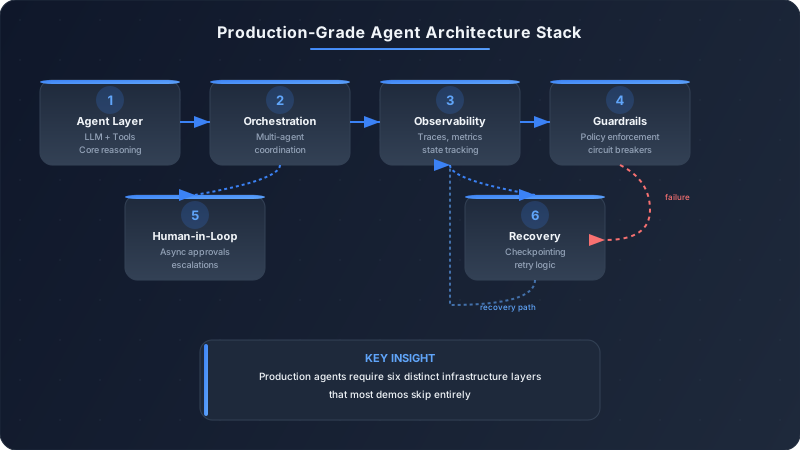
We instrument agent reasoning chains by injecting observability at the orchestration layer, not within each agent. Every agent decision emits a structured event containing: the agent's identity, the input context hash, the tools considered, the tool selected, the confidence score, and the output context hash. These events flow to a separate observability pipeline that reconstructs reasoning chains without blocking agent execution.
Performance impact: 12-18ms per decision point. Token overhead: roughly 3-5% of total token spend (because we log compressed context, not full prompts). The alternative is running blind and discovering cascading failures 36 hours after they start.
Guardrails That Don't Break at Scale
Most 'guardrails' in production agentic systems are prompt engineering theater. They add instructions like "never access production databases" or "always verify before deleting" to the system prompt, then hope the LLM follows instructions under every possible context. This breaks immediately under production load.
Real guardrails operate at three distinct layers, and you need all three:
Input validation: Before any agent sees a request, validate that it's within policy boundaries. This isn't semantic analysis (that comes later), it's structural validation. Does the request reference an allowed resource? Is it within rate limits? Does it require elevated permissions the current session doesn't have? Reject bad requests before they burn tokens.
Output sanitization: After an agent generates a response but before it takes action, sanitize the output for policy violations. This is where semantic analysis happens. Does the generated SQL query touch tables the agent shouldn't access? Does the API call exceed spending limits? Does the response contain PII that shouldn't leave the security boundary? Sanitize or block the action before it executes.
Behavioral constraints: During agent execution, enforce behavioral rules that prevent runaway processes. This is the circuit breaker layer. Has this agent made more than 50 tool calls in the last 60 seconds? Has it entered the same decision loop three times? Has token spend for this workflow exceeded the budget? Kill the workflow and escalate to human review.
Implementing Circuit Breakers for Production Agents
The infinite loop problem is real and expensive. An agent enters a reasoning loop where it keeps trying variations of the same approach, each iteration consuming tokens, each failure triggering a retry. At $0.03 per request (rough average for Claude-3.5 or GPT-4), an agent stuck in a loop for 6 hours can burn through thousands of dollars before anyone notices.
We implement circuit breakers at the orchestration layer with three thresholds:
- Decision loop detection: If an agent makes the same tool selection more than 3 times in a 10-minute window, halt execution
- Token budget enforcement: Every workflow gets a token budget (calculated as 2x the expected token spend for the task). If actual spend exceeds budget, halt and require manual approval to continue
- Execution time limits: Production workflows shouldn't run indefinitely. Set time boundaries based on task type (minutes for simple tasks, hours for complex multi-agent orchestration, days for workflows with human-in-loop steps)
Policy enforcement at the orchestration layer beats individual agent-level enforcement because it's centralized, auditable, and can't be bypassed by a compromised or hallucinating agent. If agent A decides to ignore its spending limit, the orchestration layer still enforces the workflow-level budget.
Human-in-the-Loop Without Killing Throughput
Human-in-the-loop is the escape valve that lets you deploy autonomous agents in high-stakes domains before you have perfect confidence. But most HITL implementations kill throughput by blocking agent execution every time a human needs to review something.
There are three decision points where human review actually adds value:
High-consequence irreversible actions: Deleting production data, filing regulatory reports, approving financial transactions above a threshold, terminating customer accounts. These should always route to human approval, even if the agent is 99% confident. The cost of a wrong decision outweighs the cost of human time.
Ambiguous decisions with conflicting signals: When an agent's confidence score is below your threshold (we use 0.75 for most domains, 0.85 for high-stakes), escalate to human review. But make the escalation async. Don't block the agent waiting for human input. Let it continue with lower-priority tasks while the ambiguous decision sits in a review queue.
Novel scenarios outside training distribution: If an agent encounters a request type it hasn't seen before (measured by semantic distance from historical requests), escalate for human review. This builds a feedback loop where human decisions on novel scenarios become training data for improving the agent.
The key to HITL that doesn't kill throughput: async approval workflows with context preservation. When an agent escalates a decision to a human, it should checkpoint its state, continue working on other tasks, and seamlessly resume when the human provides input. Most agent frameworks don't support this (they assume synchronous execution or force you to rebuild the entire context when resuming).
Measuring the Cost of Human Intervention
Every human review has a cost in both time and throughput. A simple framework for deciding when HITL adds value vs wastes money:
| Decision Type | Confidence Threshold | Human Review Cost | Agent Error Cost | Recommendation |
|---|---|---|---|---|
| Data deletion | Any | $15 (5 min review) | $50K+ (recovery) | Always require HITL |
| Content moderation | < 0.75 | $8 (3 min review) | $200 (reputation) | HITL below threshold |
| Document classification | < 0.85 | $12 (4 min review) | $5K (compliance) | HITL below threshold |
| Customer routing | < 0.70 | $10 (3 min review) | $50 (poor experience) | HITL below threshold |
| Report generation | < 0.80 | $20 (6 min review) | $2K (bad decision) | HITL below threshold |
Track these metrics in your first 90 days: escalation rate (what percentage of decisions require HITL), false positive rate (how often humans approve what the agent recommended), false negative rate (how often humans reject what the agent recommended), and cost per decision including human time.
The Failure Modes Nobody Shows You in GitHub Repos
The GitHub repos and blog posts show you how to build agents that work. They don't show you the five failure patterns that emerge when you run those agents in production under load with real state management requirements.
Context loss at handoffs accounts for 34% of production agent failures. Agent A processes a complex request, builds up 8,000 tokens of context, then hands off to agent B. But the orchestration layer has a 4,000 token limit for inter-agent messages. Agent B receives truncated context, makes decisions on incomplete information, and the error compounds through every downstream agent. This isn't a catastrophic failure (no exceptions, no error logs), it's silent corruption that you only detect when outputs are wrong.
Tool selection errors account for 28% of failures. An agent has access to 15 tools and chooses the wrong one based on ambiguous natural language instructions. The tool executes successfully (so no error signal), but the result is useless for the task. The agent realizes the mistake three turns later, backtracks, and tries again. Now you've burned 2x the expected tokens and introduced latency. If the agent never realizes the mistake, it proceeds with wrong information and produces garbage outputs.
Infinite loops and runaway cost account for 18% of failures. An agent tries to accomplish a task, fails, retries with a variation, fails again, retries with another variation. Each retry consumes tokens. Most retry logic uses exponential backoff for rate limits or transient failures, but that doesn't help when the agent is stuck in a reasoning loop trying different approaches to an impossible task. You need circuit breakers that detect loop patterns and halt execution.
State corruption accounts for 12% of failures. An agent checkpoints its state after completing step 3 of a 7-step workflow. Step 4 fails. The agent attempts to recover from the checkpoint, but the checkpoint contains stale data (external state changed between step 3 and step 4). Now the agent is operating on inconsistent state: it thinks it's at step 3, but the external world has moved on. This creates subtle bugs that are extremely hard to debug.
Cascading hallucinations account for 8% of failures. Agent A hallucinates a fact (maybe invents a customer ID that doesn't exist). Agent B receives that fact as input, treats it as ground truth, and builds on it. Agent C receives output from agent B, which is now two layers removed from reality. By the time agent D runs, the entire workflow is operating in a fictional universe. No single agent made an obvious error (their decisions were internally consistent), but the system as a whole produced garbage.

Designing Retry Logic for Agent Failures
Simple exponential backoff doesn't work for agents because most agent failures aren't transient. A rate limit is transient (retry in 60 seconds and it might succeed). An invalid customer ID is not transient (retrying won't make the ID valid).
We categorize failures into four types:
Transient failures (rate limits, timeouts, temporary service unavailability): Use exponential backoff with jitter, max 5 retries, escalate if still failing.
Context failures (lost state, truncated messages, stale data): Don't retry. Reconstruct context from source and restart from last known good checkpoint.
Logic failures (wrong tool selection, impossible task, hallucinated facts): Don't retry the same approach. Escalate to a different agent with different capabilities or to human review.
Systemic failures (authorization denied, resource not found, policy violation): Don't retry. These indicate the workflow shouldn't proceed. Log and halt.
State recovery after partial workflow completion requires checkpointing at the orchestration layer, not within individual agents. After each agent completes a major step, checkpoint the workflow state (agent IDs, context summaries, completed steps, pending steps). If failure occurs, recover from last checkpoint rather than restarting from the beginning. This saves token costs and reduces latency for long-running workflows.
Multi-Agent Orchestration at Enterprise Scale
Gartner documented a 1,445% surge in multi-agent system inquiries from Q1 2024 to Q2 2025. Every enterprise AI team is moving from single-agent to multi-agent architectures because the use cases demand it: customer service workflows that span multiple domains, document processing pipelines that require specialized agents for each document type, sales intelligence systems that coordinate research, analysis, and outreach agents.
But multi-agent orchestration introduces exponential complexity. Five proven patterns exist:
Supervisor/Worker: A coordinator agent receives requests and delegates to specialized worker agents. The supervisor maintains workflow state, handles failures, and synthesizes results. This pattern works for workflows where tasks are clearly separable (customer onboarding: one agent for identity verification, one for credit check, one for account setup). It breaks when workers need to collaborate or share context frequently.
Peer-to-Peer: Agents communicate directly without a central coordinator. Each agent knows about other agents and can request help or delegate tasks. This pattern works for collaborative workflows where agents need real-time context from each other (multi-agent code review where agents discuss architecture decisions). It breaks at scale (more than 5-6 agents) because communication overhead grows exponentially.
Hierarchical: Multiple layers of agents, each layer managing the layer below. Strategic agents set goals, tactical agents plan execution, operational agents perform tasks. This pattern works for complex workflows that need planning at multiple time horizons (AI-driven business strategy: strategic agents analyze market trends, tactical agents plan initiatives, operational agents execute tasks). It breaks when lower layers need to escalate decisions quickly or when agent responsibilities aren't clearly hierarchical.
Pipeline/Sequential: Agents arranged in a sequence where each agent processes the output of the previous agent and passes results to the next. This pattern works for processing workflows with clear stages (document processing: extract text, classify document, extract entities, validate data, store results). It breaks when agents need to loop back, when stages have variable execution time, or when context needs to flow backward through the pipeline.
Marketplace/Auction: Agents bid on tasks based on their capabilities and current load. A coordination layer runs an auction for each task and assigns it to the winning bidder. This pattern works for dynamic workloads where agent availability varies (multi-tenant AI system where agents come online/offline, handle different request types, and optimize for throughput). It breaks when tasks have strict latency requirements or when the auction overhead exceeds the task execution time.
Most production systems use hybrid patterns. A supervisor coordinates high-level workflow while workers use peer-to-peer for collaboration. A hierarchical planning layer feeds tasks to a pipeline execution layer. Choose patterns based on your coordination needs, not what looks clean in architecture diagrams.
MCP and the Standardization Problem
The Model Context Protocol crossed 97 million installs in March 2026, making it the de facto standard for agentic infrastructure. Every major AI provider ships MCP-compatible tooling. But production deployments at scale hit critical gaps: no standardized audit trails (every implementation logs differently), authentication tied to static secrets (no dynamic token refresh, no fine-grained permissions), undefined gateway behavior (how does load balancing work across multiple MCP servers), and configuration that doesn't travel between clients.
These aren't theoretical problems. We've seen production systems where:
- An agent's MCP connection fails mid-execution because the auth token expired, and the agent has no way to refresh it without human intervention
- Audit logs from different MCP servers have incompatible formats, making it impossible to reconstruct multi-agent workflows that span multiple servers
- Load balancing across MCP servers breaks agent state because the second server doesn't have context from the first server
2026 is expected to be the year MCP reaches full standardization with alignment to global compliance frameworks. Until then, production teams need to build orchestration layers that abstract over MCP's current limitations, provide consistent audit trails, handle auth token lifecycle, and manage state across server failures.
Security and Governance That Scales With Autonomy
48% of security professionals identify autonomous systems as the most dangerous attack vector. XM Cyber identified eight validated attack vectors specific to AWS Bedrock environments: log manipulation (attacker modifies agent logs to hide malicious activity), knowledge base compromise (attacker poisons the RAG corpus to influence agent decisions), agent hijacking (attacker takes control of an agent's execution flow), tool invocation abuse (attacker tricks agent into invoking privileged tools), context injection (attacker inserts malicious instructions into conversation context), state corruption (attacker modifies checkpointed state), escalation bypass (attacker prevents agent from escalating to human review), and audit trail deletion (attacker removes evidence of compromise).
Traditional SOC2 compliance doesn't cover autonomous agent behavior, multi-agent orchestration, or the specific failure modes of agentic systems. The controls you need:
Immutable audit trails: Every agent action, every tool invocation, every context handoff must be logged to an append-only store that agents can't modify. Even if an attacker compromises an agent, they shouldn't be able to erase evidence of the compromise. We use AWS CloudTrail with MFA delete enabled plus a separate audit pipeline that streams agent events to S3 with object lock.
Agent identity and least privilege: Every agent gets a unique identity with minimum required permissions. Agents shouldn't share credentials. If agent A needs to invoke a privileged tool, it shouldn't be able to impersonate agent B to bypass restrictions. Implement per-agent IAM roles, not shared service accounts.
Anomaly detection for agent behavior: Baseline normal behavior for each agent (typical tool usage, average token consumption, expected execution time, common error patterns). Alert when an agent deviates significantly from baseline. This catches compromised agents that start behaving abnormally.
Multi-party control for high-risk actions: Require approval from multiple agents or multiple humans for actions that could cause significant damage. One agent saying "delete this database" shouldn't be sufficient. Require confirmation from a second agent analyzing the same context or from a human reviewing the decision.
Periodic security reviews of agent capabilities: Agents accumulate permissions over time as new features are added. Quarterly, review each agent's tool access and revoke anything it hasn't used in 90 days. This reduces attack surface.
The governance gap is real: 92% of executives believe they have AI visibility, but only 76% of directors agree. The closer you get to operations, the less confidence people have in the organization's ability to track and control AI systems. This is the shadow AI problem compounded by autonomous systems that make decisions without human oversight.
Meeting Colorado AI Regulations and EU AI Act Requirements
2026 is the year of AI governance enforcement. Colorado's AI regulations require documented governance programs with measurable KPIs. The EU AI Act reaches general application with classification of high-risk AI systems and mandatory conformity assessments. What this means for production agentic systems:
- AI system inventory: Document every deployed agent, its purpose, capabilities, data access, decision authority, and risk classification
- Risk assessment: Classify agents as minimal risk (low-stakes decisions, human oversight) or high risk (autonomous decisions affecting legal rights, safety, or access to essential services)
- Impact assessments: For high-risk agents, document potential harms, mitigation measures, and monitoring plans
- Third-party due diligence: If using third-party models or tools, document their governance practices, audit their compliance, and establish contractual protections
- Model lifecycle controls: Version control for prompts, training data lineage, evaluation results, deployment approvals, and decommissioning procedures
Organizations with AI governance platforms are 3.4x more likely to achieve high effectiveness in 2026. This isn't about checkbox compliance, it's about competitive advantage. Companies that can deploy agents safely and demonstrate governance to regulators will move faster than competitors stuck in pilot purgatory worrying about regulatory risk.
The Production Readiness Checklist You Actually Need
Before deploying any agentic system to production, answer these 12 questions. If you can't answer yes to at least 10, you're not ready:
| Question | What You're Really Asking | Red Flag |
|---|---|---|
| Can you reconstruct any agent decision? | Do you have observability that shows context, tools considered, confidence scores? | Logging only final actions, not reasoning |
| Can you trace context through handoffs? | Do you know what state transferred between agents and what got lost? | Assuming handoffs are atomic |
| Do you have circuit breakers? | Can you halt runaway agents before they burn thousands in tokens? | No token budgets, no loop detection |
| Can you recover from partial failures? | Do you checkpoint state and support resume-from-checkpoint? | All-or-nothing execution with no recovery |
| Can humans intervene without blocking agents? | Is HITL async with context preservation? | Synchronous approval that kills throughput |
| Do you have per-agent identity and permissions? | Unique IAM roles per agent, not shared credentials? | All agents using one service account |
| Are audit trails immutable? | Can compromised agents delete evidence? | Logs stored where agents have write access |
| Do you detect agent anomalies? | Behavioral baselines and alerts for deviations? | No monitoring of agent behavior patterns |
| Can you explain any production decision? | Full lineage from input to action with all intermediate steps? | Black box decisions without explainability |
| Do you have chaos engineering for agents? | Tested failure injection, context loss, tool unavailability? | Only tested happy path scenarios |
| Do you measure token cost per task? | Know expected cost and alert on overages? | No visibility into actual spend vs budget |
| Do you have runbooks for agent incidents? | On-call procedures that don't require ML expertise? | No operational docs for responding to failures |
The metrics that actually matter in production:
Agent success rate: Percentage of tasks completed successfully without errors, escalations, or retries. Target: 95%+ for production agents. Track by agent type, task type, and time of day.
Average decision latency: Time from request arrival to final agent decision. Track P50, P95, P99. Latency spikes indicate context processing bottlenecks or tool invocation delays.
Escalation frequency: What percentage of tasks escalate to human review? High escalation rate means agents aren't confident (need more training data or better tools). Low escalation rate on high-stakes tasks means agents are overconfident (lower confidence threshold).
Token cost per task: Actual tokens consumed vs expected tokens for each task type. Flag tasks that consume 2x expected tokens (indicates retries, loops, or inefficient prompting).
Context handoff success rate: Percentage of handoffs where downstream agent has complete context from upstream agent. Track truncation rate and context loss patterns.
Running Chaos Engineering on Agentic Systems
You cannot debug multi-agent systems in production without having tested their failure modes in pre-production. Run chaos engineering exercises quarterly:
Context loss injection: Randomly truncate context during handoffs and verify agents detect the truncation and request full context rather than proceeding with partial state.
Tool unavailability: Randomly fail tool invocations and verify agents handle failures gracefully (retry with backoff, choose alternative tools, or escalate to human).
Rate limit simulation: Inject rate limit errors and verify agents don't enter infinite retry loops.
State corruption: Modify checkpointed state to introduce inconsistencies and verify agents detect corrupted state before continuing execution.
Agent compromise simulation: Give a red team temporary control of one agent and see if your anomaly detection catches the unusual behavior before damage occurs.
Token budget exhaustion: Let agents run with artificially low token budgets and verify circuit breakers halt execution before real budget limits.
These exercises surface the gaps in your observability, guardrails, and recovery mechanisms before real failures hit production. Document findings, prioritize fixes, and re-run exercises after fixes deploy.
What to Measure in Your First 30 Days
Deploy with conservative settings: low token budgets, high confidence thresholds, frequent human review. Collect data, tune based on actual behavior, then gradually increase autonomy.
Week 1: Measure baseline success rate and escalation frequency. You're looking for agents that escalate too often (need better tools or training) or too rarely (overconfident, may be making errors silently).
Week 2: Measure token cost per task and compare to expectations. Tasks consuming 2x expected tokens indicate retry loops, context bloat, or inefficient tool selection.
Week 3: Measure context handoff quality by sampling random handoffs and checking for truncation or data loss. If more than 5% of handoffs lose context, you have orchestration problems.
Week 4: Measure time-to-detection for agent failures. How long does it take to notice when an agent goes off the rails? If it's measured in hours instead of minutes, your observability is insufficient.
One concrete action for the next 30 minutes: Audit your agent logging. Can you reconstruct the full reasoning chain for the last agent decision in production? If not, instrument your orchestration layer before you scale.
One metric to start tracking this week: Context handoff success rate. Sample 100 random handoffs between agents and measure how many preserve complete context vs truncate or lose data. This single metric predicts most cascading failure modes.