
Your procurement team celebrated when they closed the deal. Five years, $4.2 million, predictable budget. The vendor's enterprise platform would finally consolidate your manufacturing execution systems, replace three aging tools, and deliver the unified analytics dashboard your board had been demanding since 2021.
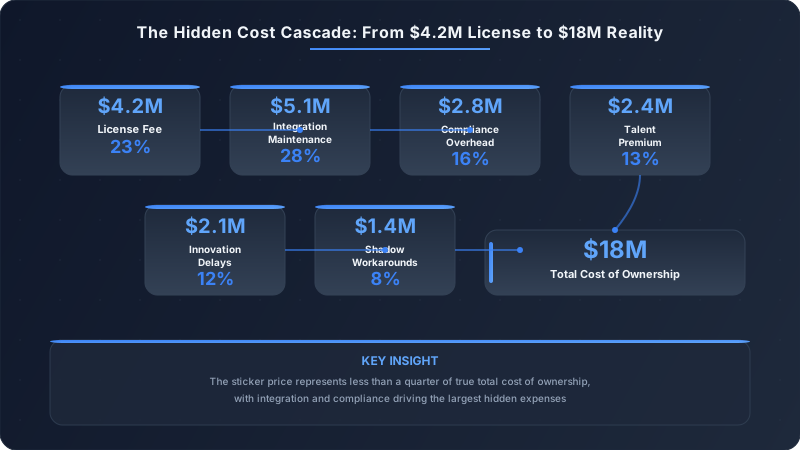
Eighteen months later, your CFO is asking why the actual spend hit $7.8 million. By year five, you'll cross $18 million. The license fee hasn't changed. What happened?
You're paying the integration tax, the compliance penalty, the talent premium, the innovation friction cost, the shadow workaround expense, and the exit insurance fee. These six hidden cost categories compound annually at rates that make your original ROI model look like fantasy. The sticker price was never the real price. It was the entry fee to a cost structure you don't control.
The $4.2M Line Item That Became $18M
Let's break down where that $13.8 million delta actually went. Your finance team sees "vendor spend" as a single line item. Your engineering team lives the real cost structure every day.
Integration maintenance consumed $5.1 million over five years. You maintained 52 custom integrations to connect the ISV platform to your ERP, MES, quality systems, inventory management, and vendor portals. Each vendor release required regression testing across every integration. You staffed a four-person integration team full-time. When the vendor deprecated an API version in year three, you spent six months and $890K rebuilding 23 integrations.
Compliance overhead cost $2.8 million you didn't budget. Your SOC 2 auditor needed evidence the vendor couldn't provide without a three-week turnaround. You built parallel audit trails in your data lake because vendor exports were incomplete. CMMC Level 2 certification required documentation the vendor's shared responsibility matrix didn't cover, forcing you to implement compensating controls. When the vendor's EU data center had an outage, you violated GDPR residency commitments and paid the regulatory fine.
Talent premium added $2.4 million to payroll. The four vendor-certified specialists you hired commanded 35% higher salaries than your cloud engineers. Training new team members cost $12K per person annually for certification and recertification. When your lead specialist left in year three, the replacement search took six months and required a retention bonus for the hire. That skillset doesn't transfer. Those engineers are locked in as tightly as you are.
Innovation delays created $2.1 million in opportunity cost. You deferred the predictive maintenance feature for 14 months waiting for the vendor's analytics upgrade. Your competitor shipped their version in four months using Lambda and SageMaker, capturing market share you're still fighting to reclaim. The real-time quality monitoring dashboard waited 11 months for a vendor roadmap slot. Thirty-seven feature requests died in the vendor's backlog, never prioritized.
Shadow workarounds cost $1.4 million in duplicate effort. Your plant operations teams built 19 unauthorized integrations using Python scripts and RPA tools because the vendor's workflow engine couldn't handle their edge cases. IT discovered these during a security audit. Three departments were exporting vendor data to spreadsheets and Google Sheets daily because the reporting interface was too slow. The compliance team had no visibility into any of it.
That $18 million wasn't waste. It was the actual cost of running a vendor-dependent architecture at enterprise scale. The problem isn't that you made a bad decision five years ago. The problem is that nobody modeled these six cost categories when evaluating the business case.
The Integration Tax: Why Every Update Costs Six Figures
Your integration layer is a time bomb on a quarterly timer. Every ISV release resets the clock.
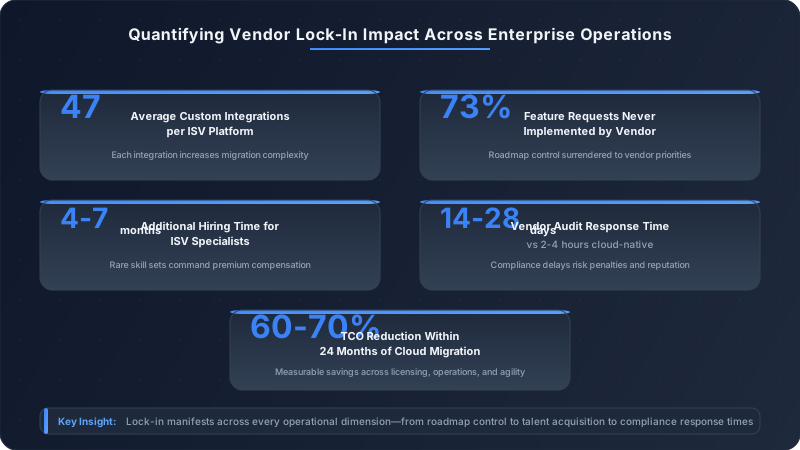
The average enterprise maintains 47 custom integrations per major ISV platform. Each integration is a dependency chain. The vendor updates an API response structure. Your integration breaks. The downstream system expecting that data structure breaks. The dashboard consuming that system's output breaks. The compliance report reading from that dashboard breaks. One API change cascades through four systems.
You'll spend 120 to 400 hours regression testing every major vendor release. Not just testing the vendor's new features. Testing that nothing broke in your ecosystem. Your QA team maintains test suites covering every integration permutation. When the vendor ships a new version, you have two weeks to validate before they deprecate the old API. If you miss the window, you're running unsupported code.
API versioning chaos forces you to maintain 3 to 5 concurrent API versions simultaneously. The vendor's deprecation timeline doesn't align with your release cycles. Your newest integration uses v4 of the vendor API. Your quality system integration is stuck on v2 because upgrading requires recertification that takes eight weeks. Your inventory system is mid-migration from v2 to v3. Your finance integration is on v1 because rebuilding it isn't prioritized. You're now testing against five API versions for every vendor release.
Shadow integration proliferation makes this exponentially worse. IT knows about 47 integrations. Your departments built 22 more that IT doesn't control. Operations has Python scripts hitting the vendor API every 15 minutes. Sales has Zapier workflows syncing data to Salesforce. Finance has an Azure Function pulling nightly reports. These shadow integrations don't show up in your regression testing. They break in production during peak business hours.
Real cost per major ISV release cycle: $85K to $240K in testing, remediation, and emergency fixes. That's four to ten releases per year. You're spending $340K to $2.4M annually just keeping integrations working, before you build a single new capability.
The Innovation Brake: When Your Roadmap Waits for Vendor Releases
Your product team planned eight major features this year. You'll ship three. The other five are blocked waiting for vendor capabilities that may never arrive.
Enterprises defer 40% to 60% of planned features waiting for vendor roadmap alignment. You can't build predictive quality analytics until the vendor ships their ML module. You can't implement real-time cost optimization until they support streaming data ingestion. You can't launch the customer portal until they expose the APIs your UX team needs. Your roadmap is hostage to someone else's priorities.
The quarterly release trap forces waterfall thinking in agile organizations. Your teams work in two-week sprints. Your vendor ships updates every 90 days. You batch feature work into quarterly chunks to align with vendor releases, destroying the responsiveness that made you adopt agile in the first place. Your standup boards fill with items marked "Blocked: Waiting for vendor Q3 release." You're running agile ceremonies on a waterfall delivery schedule.
Competitive velocity impact shows up in market share. Companies locked into ISV roadmaps ship new capabilities 3 to 4 quarters behind cloud-native competitors. Your competitor launched AI-driven demand forecasting in January. You're waiting for your vendor's AI module roadmapped for Q4. By the time you ship, they've iterated through three versions and captured the early adopter market. You're permanently playing catch-up.
Feature request purgatory kills 73% of enterprise feature requests before they reach a vendor roadmap. You submit a feature request with business justification, customer demand data, and willingness to be a design partner. The vendor's product team adds it to the backlog. Six months later, it's "under consideration." Twelve months later, it's still "under consideration." Eighteen months later, you've built a workaround outside the vendor platform because you can't wait anymore. The feature never ships.
One financial services firm lost a $12 million market opportunity waiting 18 months for their ISV's analytics upgrade. They'd identified a new regulatory reporting product that required real-time data aggregation across eight systems. Their vendor couldn't support it. By the time they built a parallel analytics stack outside the ISV platform, two competitors had captured the market and regulatory requirements had changed. The opportunity closed. The investment was wasted.
Your roadmap shouldn't depend on someone else's product meeting. The innovation brake isn't just slowing you down. It's stopping you from competing.
The Compliance Time Bomb: Audit Trails You Don't Control
Your auditor asks for evidence. Your vendor says 14 to 28 days. Your competitor running cloud-native infrastructure exports the same evidence in 2 to 4 hours. Guess who passes the audit faster.
SOC 2 and CMMC dependency risk is concentrated. Ninety-one percent of compliance failures trace to vendor-controlled documentation gaps. You're responsible for proving your security controls work. But you can't access the vendor's change logs. You can't demonstrate their encryption implementation. You can't show their access control audit trail. The compliance framework holds you accountable for controls you don't operate. When the auditor finds gaps, you fail certification. When you fail certification, you lose contracts.
Data residency constraints become geographic limitations on your business. Your vendor operates two data centers: US-East and EU-West. Your Japan expansion requires data residency in Asia-Pacific under local regulations. The vendor doesn't offer it. You now choose between violating local law or exiting a $40M market opportunity. ISV platforms force impossible tradeoffs between compliance and growth.
Audit response delays stack up during certification cycles. You request transaction logs from the vendor on Day 1. They acknowledge on Day 3. They deliver partial data on Day 18. The auditor identifies gaps on Day 22. You request supplemental logs on Day 23. The vendor delivers on Day 41. Your 90-day certification window is half gone waiting for vendor evidence. Cloud-native architectures let you export audit evidence in hours, not weeks. The time difference determines whether you pass certification on schedule or blow the deadline.
Shadow AI governance gap creates regulatory exposure nobody's tracking. Sixty-seven percent of CISOs lack visibility into AI usage across their organizations. Your ISV platform embedded AI capabilities in their latest release. Your teams are now using AI features you don't govern. What data are they processing? What models are they calling? What personally identifiable information are they exposing? You discover the gap when the auditor asks about your AI governance framework. You have no documentation because you didn't know the capability existed. This isn't theoretical. It's happening in March 2026 as vendors race to ship AI features without proper enterprise governance frameworks.
The exit audit nightmare materializes when you try to leave. You request a complete data export. The vendor provides 60% to 70% of your data in CSV format. Transaction metadata isn't included. Audit logs aren't included. Configuration history isn't included. Integration mappings aren't included. You're migrating to a new platform without the evidence needed to prove continuity of controls. Your next audit fails because you can't demonstrate an unbroken chain of custody. The compliance time bomb detonates during the transition, not during steady-state operations.
The Talent Trap: Paying Premium for Scarce Vendor Skills
Your cloud engineers cost $140K. Your vendor-certified specialists cost $195K. The vendor specialist's skills transfer to exactly one other job: another company using the same vendor platform. The cloud engineer's skills work anywhere.
Specialist salary premium hits 25% to 40% above cloud-native peers. Vendor-certified talent is scarce because the certification path is expensive, the skillset is narrow, and the market is small. You're competing with every other enterprise running the same platform for the same small talent pool. When you win that competition, you pay market-clearing rates. When you lose, your projects stall waiting for the next candidate.
Narrow skill portability creates retention risk. Sixty to seventy percent of ISV platform skills don't transfer to other roles. Your vendor specialist knows the platform's proprietary scripting language, its specific workflow engine, its particular integration patterns. Those skills are worthless at a company running a different vendor or cloud-native architecture. The specialist's next job is either internal promotion or external move to another company with the same vendor. Their career path is artificially constrained. Your retention risk is elevated because their market mobility is limited.
Retention risk concentration turns key person dependencies into project delays. Lose one senior vendor specialist and projects slip 3 to 6 months. The knowledge is concentrated. The replacement market is thin. The ramp-up time is long. One resignation cascades into delayed releases, overtime costs across the team, and executive pressure to fast-track undertrained replacements. You're one resignation away from a roadmap catastrophe.
Training treadmill costs accumulate. You'll spend $8K to $15K per engineer per year for vendor certification and recertification. The certifications expire. The vendor updates the platform. The training content changes. You're buying the same certification twice to keep engineers qualified on capabilities you already deployed. This isn't professional development that broadens their skills. It's maintenance expense to preserve status quo expertise.
Hiring timeline impact materializes when you have an open role. ISV platform roles take 4 to 7 months to fill. Cloud-native Kubernetes and AWS roles take 2 to 3 months. The talent pool is 5x larger for cloud skills than vendor-specific skills. You're waiting an extra 2 to 4 months per hire, extending project timelines and forcing teams to carry technical debt longer while you search for the unicorn who knows your vendor's ecosystem.
The talent trap isn't just a cost problem. It's a strategic fragility. Your technology choices determine your hiring speed, retention risk, and team capability growth rate. Vendor-dependent architectures systematically degrade all three.
The Exit Cost Explosion: Why Migration Math Never Works
The vendor quotes "full data export capability" in the contract. Three years later, you discover 30% to 40% of operational data is trapped in proprietary formats the export function doesn't touch.
Data extraction reality shows up when you plan migration. The vendor exports customer records, order history, and inventory snapshots. They don't export workflow state, integration transaction logs, calculated fields from their proprietary analytics engine, or the configuration metadata that documents how you customized the platform over five years. You need that data to migrate safely. It's trapped. You'll manually recreate it or lose it.
The sunk integration paradox makes CFOs hesitate. Your teams invested 200,000 hours building custom integrations over five years. That's $18 million to $24 million in loaded labor cost. The migration business case requires admitting that investment is sunk. Behavioral economics says people irrationally avoid losses more than they pursue gains. Your executive team anchors on the sunk cost and delays the migration decision while the lock-in deepens.
License termination penalties are contractual traps. Early exit fees typically run 50% to 150% of remaining contract value. You signed a five-year deal worth $4.2 million. In year three, you want out. The penalty is $1.8 million to $3.2 million to terminate. The vendor knows switching costs are high. The penalty ensures you stay through contract expiration even after you've decided the relationship isn't working. You're financially locked in beyond the technical lock-in.
Parallel operations period doubles infrastructure costs. You'll run both old and new systems for 6 to 18 months during migration. You're paying vendor licenses for the old platform while paying cloud infrastructure costs for the new platform. You're staffing both teams. You're maintaining integration layers into both systems. Your infrastructure budget doubles temporarily while business value doesn't increase. The CFO sees a cost spike right when you promised cost reduction.
AWS Transform's portability shift represents the first hyperscaler competing explicitly on exit costs. AWS announced features that preserve optionality, support transitions between AI vendors, and make open source alternatives viable. Making exit costs a product feature changes customer negotiation dynamics. If cloud providers compete on how easy they make it to leave, ISV vendors face new pressure. You're no longer choosing between expensive exit from one vendor and expensive lock-in to another. You're evaluating portable architectures that reduce future switching costs to manageable levels.
The migration math never worked because vendors price for lock-in. The exit cost explosion isn't accidental. It's the business model.
The Moonshot Alternative: Cloud-Native Economics
ISV costs compound at 12% to 18% annually. Cloud-native costs scale linearly with usage. The total cost curves diverge dramatically by year three.
Compare the economic models. You pay ISV vendors per user, per module, per transaction, per integration, per environment. Every dimension has a separate multiplier. Scale your user base and costs rise. Add an integration and costs rise. Deploy a dev environment and costs rise. The pricing model taxes growth. Cloud-native pricing taxes resource consumption. You pay for compute when you compute, storage when you store, network when you transfer. Scale your user base without increasing resource consumption and costs don't rise. The incentive structure is fundamentally different.
Lambda Durable Functions impact shows up in workflow costs. Durable Functions maintain stateful workflows up to one year without idle compute charges. Traditional ISV workflow engines charge you for workflow orchestration capacity whether workflows are running or waiting. You pay for idle time. Lambda bills for execution time. A workflow that runs for 20 seconds then waits 8 hours for human approval costs 20 seconds of Lambda execution. The ISV workflow engine bills for 8 hours and 20 seconds of capacity reservation. That's a 1,440x difference in cost structure for the same business outcome.
API standardization benefit gets real with MCP adoption. MCP crossed 97 million installs by March 2026, becoming de facto infrastructure. Every major AI provider ships MCP-compatible tooling. The integration complexity equation changes from quadratic (every system integrates with every other system) to linear (every system integrates with MCP once). Adding the 48th integration in an ISV architecture means testing 47 existing integrations for regression. Adding the 48th MCP-compatible system means testing one MCP connection. The testing burden drops from hundreds of hours to tens of hours.
Talent economics flip when you hire for cloud skills instead of vendor skills. Cloud-native engineers command $140K to $160K with skills that work across any company running AWS, Azure, or GCP. That's 60% of the job market. ISV specialists command $180K to $220K with skills that work only at companies running the same vendor platform. That's 2% of the job market. The talent pool is 30x larger for cloud roles. Time to fill drops 40% to 50%. Retention improves because career mobility improves. The talent economics favor cloud-native architecture before you account for technical benefits.
Real migration ROI materializes within 24 months. Enterprises achieve 60% to 70% TCO reduction by year two after ISV-to-cloud transition. The cost curve doesn't just flatten. It drops. Integration maintenance costs fall 65% to 75% when you control the infrastructure. Compliance response times fall 85% to 90% when you own the audit trail. Talent acquisition costs fall 40% to 50% when you hire for portable skills. Innovation velocity doubles when roadmap decisions move from vendor product meetings to internal sprint planning. The business case isn't marginal. It's overwhelming.
The Architecture Decision Matrix: Vendor vs. Cloud-Native Trade-Offs
Not every workload belongs in a cloud-native architecture. Not every vendor relationship creates unacceptable lock-in. The decision framework needs to be explicit about trade-offs.
| Scenario | ISV Platform | Cloud-Native | Recommendation |
|---|---|---|---|
| Commodity business process (HR, payroll, travel expense) | Lower initial implementation cost, vendor handles compliance burden | Higher build cost, you own maintenance | ISV Platform - standardization is an advantage, differentiation isn't valuable |
| Core differentiating capability (pricing engine, fraud detection, customer matching) | Vendor roadmap controls your competitive timeline, customization hits pricing penalties | Full control of feature roadmap, innovation velocity limited only by team capacity | Cloud-Native - competitive advantage requires independent capability development |
| Highly regulated data (PII, ITAR, FedRAMP, CMMC Level 3+) | Vendor compliance gaps create risk you can't fully mitigate, audit response SLAs inadequate | Direct evidence access, 2-4 hour audit response, full control of data residency and encryption | Cloud-Native - compliance requirements exceed what vendor shared responsibility model provides |
| Stable, low-change workload (reporting warehouse, archival storage, read-only analytics) | Predictable costs, minimal integration maintenance if upstream systems are stable | Cost-efficient for storage and compute, but migration investment may not justify stable workload ROI | ISV Platform - if upstream dependencies are also stable, lock-in risk is contained |
| High-growth, scaling workload (customer-facing APIs, real-time data processing, ML inference) | Costs compound with scale, per-transaction pricing becomes prohibitive at volume | Linear cost scaling with usage, auto-scaling handles spikes without pricing penalties | Cloud-Native - ISV pricing models designed for predictable enterprise scale, not exponential growth |
The pattern is clear: vendor platforms work for commodity undifferentiated capabilities where standardization is valuable. Cloud-native architecture wins for differentiating capabilities, regulated data, and high-growth workloads where vendor pricing models and roadmap control become strategic constraints.
You shouldn't migrate everything. You should be ruthlessly explicit about which capabilities must remain under your architectural control to preserve competitive advantage and which capabilities can safely run on vendor infrastructure.
Building Your Exit Strategy: The 90-Day Readiness Plan
The time to plan your exit is before you're desperate to leave. The negotiation leverage exists before contract renewal, not after.
Week 1-2: Map your integration dependency graph. Visualize every integration touching the vendor platform. Identify the 20% of integrations driving 80% of your maintenance burden. Those are your migration priorities. If six integrations account for 60% of your regression testing hours, those six are your candidates for cloud-native rebuild. Don't try to migrate all 47 integrations. Migrate the painful ones that justify the investment. Document the dependencies so you understand the blast radius of change.
Week 3-4: Calculate your true ISV TCO using the seven-factor model. License fees, integration maintenance, compliance overhead, talent premium, opportunity cost, exit risk insurance, and innovation friction. Pull actual numbers from finance, hiring data from HR, project delay data from your PMO, and incident response costs from your ops team. The real TCO is 4x to 7x the license line item. Build the spreadsheet that shows it. Your CFO needs that model for the next budget cycle and contract renewal negotiation.
Week 5-8: Identify your top three ISV constraints and start parallel cloud development. Don't wait for budget approval to rearchitect the entire platform. Pick the three capabilities causing the most pain and build cloud-native alternatives in parallel. The real-time dashboard stuck waiting on vendor analytics? Build it with Lambda, Kinesis, and QuickSight. The workflow automation blocked on vendor roadmap? Implement it with Step Functions. The integration that breaks every vendor release? Replace it with EventBridge and MCP. Prove the alternative works before you ask for migration budget.
Week 9-12: Establish the metric that matters: time-to-independent-capability. For each core business function currently ISV-dependent, measure how long it takes to ship a new capability end-to-end. That's your baseline. As you shift capabilities to cloud-native architecture, remeasure time-to-independent-capability. Competitive advantage comes from speed. If your vendor-dependent capabilities ship new features in 180 days and your cloud-native capabilities ship in 45 days, you have quantified the innovation tax. Track it monthly. Report it to your executive team. Make velocity visible.
The 90-day readiness plan doesn't require executive buy-in or a migration budget. It requires you to stop accepting vendor constraints as inevitable and start building alternatives that prove a better path exists.
That original $4.2 million contract that became $18 million wasn't inevitable. It was the result of not modeling integration tax, compliance penalties, talent premiums, innovation friction, shadow workarounds, and exit costs upfront. The cost categories were predictable. The multipliers were knowable. The next contract renewal is your chance to negotiate with the real TCO model visible. The architecture decisions you make this quarter determine whether you're still trapped five years from now or running a system you control.