- Solutions

- Industries
Check out the best opportunities for:


Generative AI has moved beyond experimentation inside large organizations. Pilot systems are already in place, and internal teams understand how foundation models behave in controlled environments. The challenge now is operational maturity.
Turning a prototype into a production-grade system requires more than scaling infrastructure. It demands architectural discipline, governance integration, and sustained monitoring across enterprise workflows. Without that structural foundation, early success remains isolated rather than institutionalized.
Operationalizing generative AI means transforming experimental capability into reliable enterprise systems that can withstand real workloads, regulatory scrutiny, and long-term cost pressures.
Initial deployments typically focus on proving feasibility. A model is connected to a curated dataset, prompts are refined, and a functional interface is delivered to a limited user group. The system performs well because complexity is constrained.
At this stage, teams prioritize speed and demonstration value. Evaluation is often manual. Data scope is narrow. Integration points are limited. Governance review is lightweight.
This approach serves its purpose. It confirms that foundation models can accelerate knowledge retrieval, assist with content generation, or support internal operations.
However, pilots do not reflect enterprise conditions. They rarely account for distributed data ownership, production-level traffic, regulatory oversight, or lifecycle management. As organizations attempt to expand usage, architectural gaps become visible. What functioned effectively in isolation encounters friction within core systems.
Pilots establish capability. They do not establish durability.
The move from pilot initiatives to production deployment is not a simple expansion of scope. It represents a fundamental shift in how generative systems are designed, governed, and supported.
In early-stage experimentation, generative AI operates within controlled boundaries. Data exposure is limited. Oversight is informal. Integration depth is narrow. The system exists primarily to validate feasibility and surface potential use cases.
Production environments introduce different constraints. Systems must interact with distributed enterprise data sources, enforce role-based access consistently, and meet defined reliability targets. Responsibility expands beyond innovation teams to include platform engineering, security, compliance, and operations leaders.
The distinction spans multiple dimensions:
When these dimensions are viewed together, the gap between pilot initiatives and production deployment becomes clear. Operationalizing generative AI requires coordinated changes across technology, process, and accountability structures.
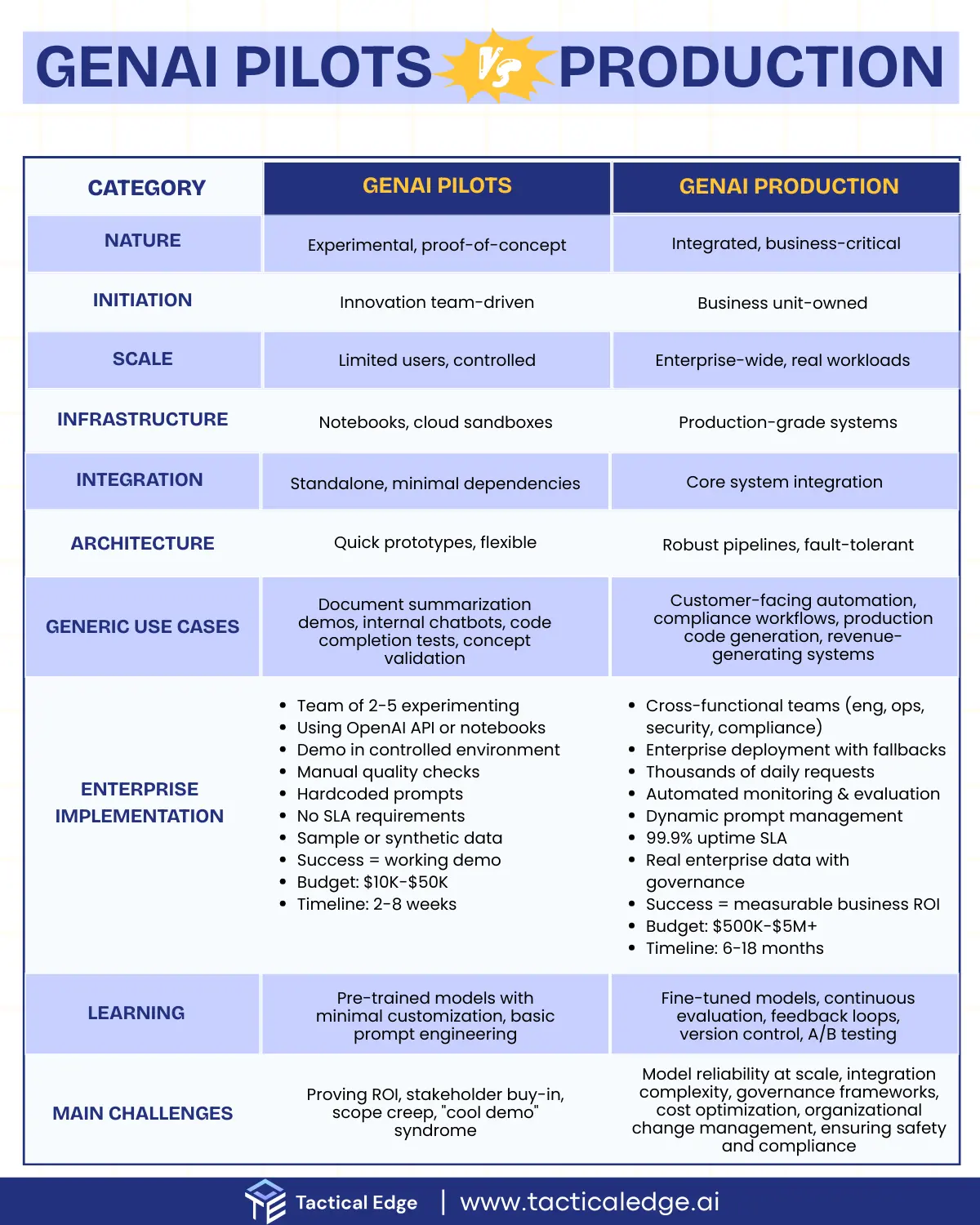
This comparison highlights that scaling generative systems is not a matter of increasing usage. It is the deliberate engineering of production-ready enterprise AI infrastructure.
Production deployment establishes reliability, but enterprise integration extends beyond initial rollout. Generative systems evolve through a defined lifecycle as adoption expands and operational expectations increase.
This lifecycle typically progresses through four stages:
Each phase introduces additional architectural and governance requirements. Early validation confirms capability. Production deployment formalizes reliability standards. AI-native operations address variability and orchestration complexity. Enterprise-wide optimization integrates cost management, observability, and compliance into daily workflows.
The progression is cumulative rather than linear. Later stages do not replace earlier ones; they build upon them. As generative AI becomes embedded in core systems, oversight mechanisms mature and integration depth increases.
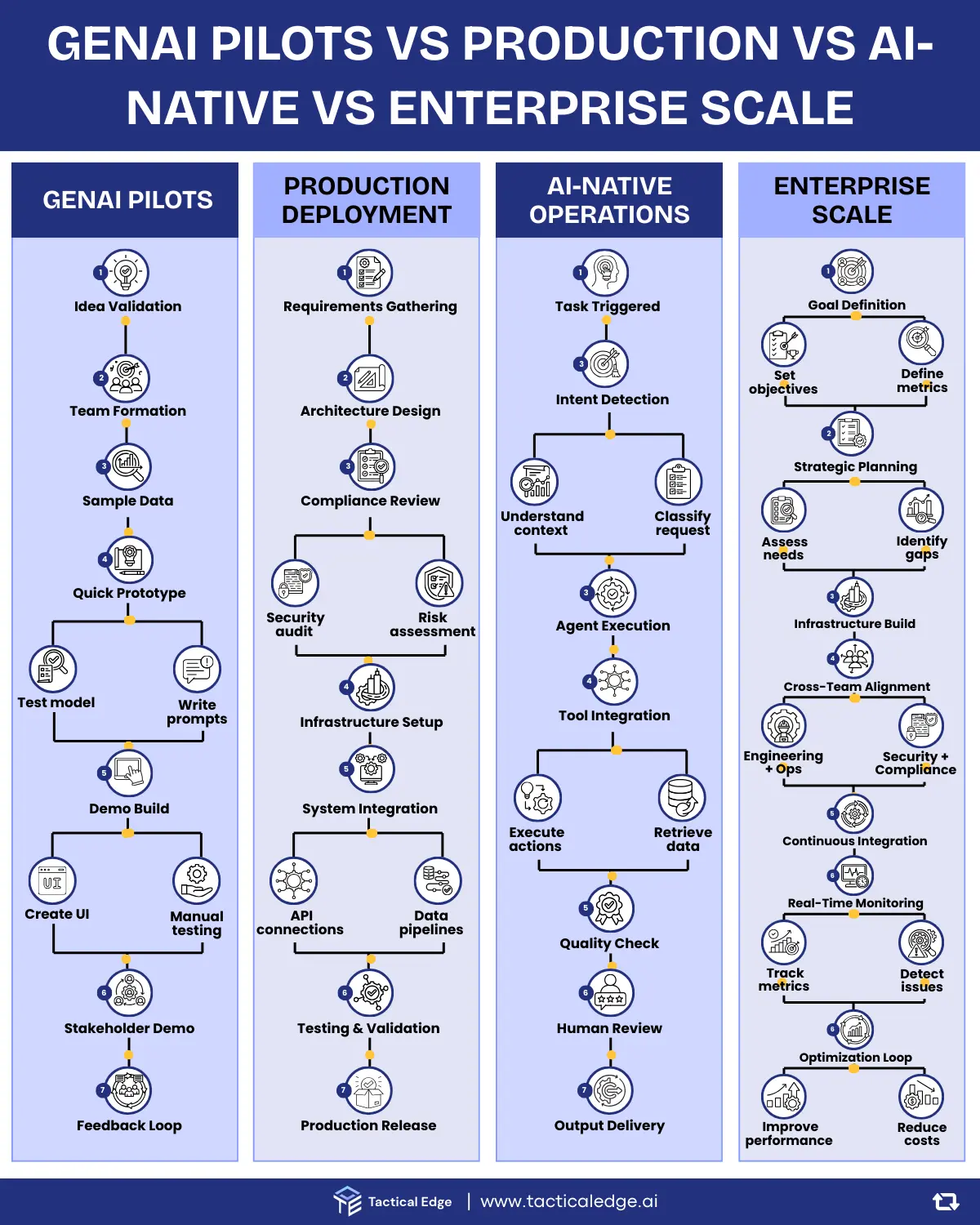
Understanding this deployment lifecycle clarifies why operationalizing generative AI is an ongoing discipline. It requires continuous refinement of infrastructure, governance, and monitoring practices as enterprise reliance grows.
Moving into production formalizes ownership. Generative AI transitions from an experimental tool to a supported system component embedded in business workflows.
This shift introduces new requirements. Architectural design becomes deliberate. Infrastructure must meet reliability standards. Security controls move from conceptual to enforced. Cross-functional review becomes routine.
Production readiness typically includes:
Integration complexity increases as well. Generative systems must interact with enterprise data stores, workflow engines, and internal APIs. Retrieval logic must enforce role-based permissions consistently. Logging frameworks must capture inputs and outputs for traceability.
Performance expectations also change. Systems must maintain predictable response times under sustained load. Failure scenarios must be anticipated and contained. Monitoring tools track latency, infrastructure health, and cost patterns in real time.
At this stage, operationalizing generative AI is fundamentally about system engineering rather than prompt refinement.
Once generative systems operate within live environments, a different operational model emerges. Unlike conventional services, these systems exhibit probabilistic behavior influenced by prompts, retrieval configurations, and upstream model updates.
An AI-native operational approach acknowledges this variability and manages it systematically.
Generative workflows are often composed of multiple stages: intent detection, context retrieval, response generation, and post-processing validation. In some cases, orchestration layers coordinate multi-step task execution or agent-based logic. Each component introduces dependencies that require oversight.
To manage this complexity, organizations implement structured controls:
Observability extends beyond traditional uptime metrics. Enterprises monitor response consistency, output drift, token consumption, and cost efficiency. Behavioral changes are evaluated before broad deployment.
This operational maturity distinguishes systems that merely function from those that scale responsibly.
As adoption expands across departments, generative AI becomes part of the enterprise technology fabric. At this scale, governance and optimization are not discrete initiatives; they are ongoing practices.
Enterprise-scale deployments require alignment across engineering, operations, finance, and compliance teams. Clear objectives are tied to measurable outcomes. Performance indicators track reliability, efficiency, and value delivery.
Sustained maturity typically involves:
Financial oversight becomes integral. Inference usage, retrieval architecture efficiency, and infrastructure scaling decisions directly influence operating budgets. Continuous refinement ensures that expansion does not compromise sustainability.
Governance also evolves. Policies governing data access, output validation, and system accountability are embedded into architectural controls rather than managed manually.
Enterprise-scale generative AI is not defined by model sophistication alone. It is defined by consistent performance within established operational boundaries.
The progression from pilot to enterprise system reflects increasing structural discipline.
Early experiments validate potential. Production engineering formalizes reliability. AI-native operations manage dynamic behavior. Enterprise scale embeds governance and optimization into the technology lifecycle.
Organizations that operationalize generative AI effectively recognize that competitive differentiation no longer rests on access to advanced models. It rests on disciplined integration across data architecture, monitoring frameworks, and governance controls.
When generative systems are engineered to operate predictably within enterprise infrastructure, they transition from innovation initiatives to durable institutional capabilities.
Operationalizing generative AI is therefore not a deployment milestone. It is a sustained commitment to engineering rigor, operational oversight, and long-term value realization.


Check our latest featured and latest blog post from our team at Tactical Edge AI
Accelerate value from data, cloud, and AI.
Copyright © Tactical Edge All rights reserved
.svg)
.svg)
.svg)
%20(1).webp)